Thursday, June 4, 2009

Scanning the Great Firewall of China


As the nations of the world prepare to mark the Twentieth Anniversary of the weeks-long student-led pro-democracy demonstrations crushed on June 4th in Beijing’s Tiananmen Square, The People’s Republic of China, twelve hours ahead of us, is already suppressing it.

The news is not controlled, it’s stifled. Television crews are banned from the Square. Access to Internet sites is blocked. Popular social networking sites such as Twitter, Flickr and Hotmail are effectively shut down. The Great Firewall of China has wound its way through the inroads of progress, ostensibly rendering modern China impregnable again. But for how long?

“Something there is that doesn’t love a wall,” wrote U.S. Poet Laureate Robert Frost. Will it be Chinese students again? Or the offspring of the workers who supported them so ardently twenty years ago? Whatever it is “That sends the frozen-ground-swell under it,” as Frost has it, will invariably have to surface from Chinese soil. What we know, from Jericho to Berlin, is that even in the face of the seemingly impossible, unwelcome, untenable walls come tumbling down.

Two Chinas, the mainland and Taiwan, are slowly, but no one will say surely, becoming one China—aren’t they? Invisible walls prevail. Ten days ago, I was one of six journalists invited to fly from mainland China to Taiwan for the first time in sixty years. More was made of it here than in China. Applying for a visa in New York, I was told that being a “writer” was a problem—“We don’t want you to write anything critical of us.” I was up against a wall—until I asked why they would expect something critical. I got the visa. So nothing I say is critical.

BUT. Here’s where the information factor becomes critical. I have seen first hand what a communist-controlled education can do to people, in the Former Soviet Union, in Mongolia, and in [censored]. It deprives them of the ability to think for themselves, to make decisions and to take responsibility for them. It primes them for taking orders and strips them of any notion under the sun of not following them.

Still, contradictions abound. The educated are super-educated. Three consecutive guides learned English in Chinese schools and spoke it better than many an American I’ve heard. When someone used any English word they didn’t know, they took a small electronic gizmo out of a pocket or pocketbook, entered the word, read the definition provided on the screen and “saved” it. The management and staffs of the hotels we stayed in, the grandest of Grand Hyatts in Beijing, Shanghai and Taipei, were fluent, fast on the uptake (and we gave them plenty to take up, and in) and charmingly, often wittily, responsive.

All things computed, the “new” China is better served without firewalls.

Sunday, May 31, 2009

Sino Sign Language


May we remind you: please be self-restraint and be a good tourist to mold a well-mannered imagination.

So read the sign welcoming me to Beijing’s Jingshan Park. To the degree I understood it, I honored it. My “well-mannered imagination,” however, had unruly ideas of its own.
If China is a nation of 1,330,313,812 people, where were they? If one in every five people on the planet is a resident of China, did they prefer to reside indoors? While Japanese and Korean tourists abounded, with touring Chinese supplementing their numbers, the locals were notably scarce. Our small gaggle of journalists looked for telling signs—pets, children, laundry, waiting lines, wild life and indigenous music—and came up with vendors and trinkets, service people and shop clerks, humming bikes and still waters. When the loudest sounds in a country emanate from Buddhist temples, a New Yorker has to ask: is this Nirvana or Neurasthenia?


The plaque, above, urging the reader to “Take the initiative to classify discards of paper… or gourd skin,” also tells him or her to “Cherish the resources,” “Don’t talk or laughter loudly in the scenic area,” “Don’t shin or overstep the rockery” and “Don’t urinate or defecate.” No one in my company did any of the latter things in my presence.
 
Not with reminders like these:


China teems with culture on the calm. Tiananmen Square is a procession of the orderly. The Chinese have become Olympic smilers. I didn’t hear raised voices. Everything is a negotiation. Even navigating large vehicles in heavy traffic is a negotiation. 
 
If any sign exists that says “No raised voices,” I didn’t see it. So I raised mine. I sent a pair of cotton slacks to be washed and ironed at the Grand Hyatt, Taipei. I told them the bottom hems were frayed before they told me. “Just do the best you can and don’t worry about it,” I said. Over the next six phone calls from housekeeping and the laundry, I found half a dozen additional ways to tell them the same thing, not to concern themselves with the pants, just do the best they could, that would be fine. When I returned to my room at 11:30 that evening, my phone was ringing. The seventh person was calling to tell me my pants were damaged. Is it possible the “Banana Republic” label intimidated them? I certainly didn’t. A gentleman came to my door. Out of patience, I raised my voice. He smiled. And they did a beautiful job.
 
Maybe this sums it up:

Thursday, May 28, 2009

Three Guides and One Twilight Zone in the Two Chinas


Sabbath in the Lama Temple with Zion

When the professor escorting an irreverent band of six journalists through Beijing says it's time to return to Zion, he's not thinking of the Holy Land or Zionism—he's trying to collect us and shepherd us back to our touring van and our Chinese superguide, Zion Zhu.

Zion, the son of missionaries, knows everything there is to know about: the Ming, the Qing and every other dynasty in China's long history; Nyngmapa and Galupa and presumably any other kind of Buddhism; and Hollywood movies. Ask Zion how he knows an English word he's just surprised you with and he'll tell you the film he learned it from. Then he'll tell the driver to "hang a right."

In addition to the “usuals,” the Great Wall, the Forbidden City, et al, Zion led us to "Longevity Hill," and through the Lama Temple and "The Hall of Longevity"—the hall of you should live so long, as I like to think of it.


Tuesday in the Park with Teresa

As Shanghai-modish as Beijing is quaint, our guide Teresa graced and grinned us through the gardens, canals, tunnels and towers of Shanghai. Teresa eschews a business card for a rubber stamper, a delicate pink one, which she uses to imprint her name and cell phone number on the document you’re least likely to lose. (That she presented the stamp after she lost me once is a Chinese puzzle.) Not exactly traipsing over hill and dale, we followed Teresa through the Humble Administrator’s Garden, the Master of the Fishing Nets Garden, Blood Alley and Tiger Hill. I remain seduced by the poetry of the names.

They say the national bird of China is the crane. The Chinese wear face masks to prevent contagion from foreigners bearing flu, but it is the edifice complexes that are catching. Park Hyatt Shanghai boasts of having the highest restaurant in the world. A presidential suite at Shanghai’s Hyatt on the Bund becomes “The Emperor’s Suite.” It followed that I was dubbed—by the incongruous professor of architecture and comedy—the Son of the Cucumber Emperor.


‘Tis the Season to Be Airy

“September Song” declares, “It’s a long, long time from May to December.” In an inscrutable reversal, Air China gave us December in May by piping “Oh Come All Ye Faithful” into its cabin of seven sole Caucasians amid an untold horde of Asian passengers airborne between two predominantly Buddhist countries, China and Taiwan. “Oh cuh-uh-ome all ye-ye fai-yay-aithful.” A gospel-soul rendition, in English. Ha-al-lelu-oo-oo-yah and amen. The evergreen Christmas Carol, the lone musical offering, was so felicitous for take-off they repeated it on landing.


Four Days on the Road with Lily

Bitten by the mine’s-bigger-than-yours bug, Taiwan’s capital, Taipei, boasts of the tallest building in the world (for now). Be that as it may, the poetry of Taiwan is the roll call of the cities. By bus, plane and bullet train the Caucasians go rolling along. Taipei to Taichung to Lugang to Tainan to Kaohsiung to Hualien to Taroka. A street festival, a lantern shop, a night market, a foot massage. A serene trek through the sublime Taroka Gorge, for which there are no adequate words or camera lenses. And everywhere, our Taiwanese guide Lily charging forward to rein in the pace-setter of the pack and scampering back to bring up the laggards. Pen to pad, camera in hand or short on breath, I am laggardly.

Monday, May 18, 2009

Natural Resource


All natural resources aren't vegetable or mineral. Isaac Asimov's business card read "Natural Resource."

Shortly after Isaac died, his widow Janet and I reminisced over lunch. We both acknowledged that thanks, or no thanks, to Isaac's encyclopedic brilliance, we'd forgotten how to look things up. She would walk into the next room, I would pick up the phone, to ask him anything. I think he knew everything.

The prolific author/genius didn't resemble his byline. He had a tenor voice, white muttonchops and always wore a bolo tie.

He called, excitement and laughter in his voice on this occasion, to tell me an incomparable tale. Isaac belonged to a group of intellects called "The Trap Door Spiders," who met once a month. He trapped me twice by taking me to a private dinner with them where they grilled the guest, who was me--initially, without warning--on a topic he was deemed expert on. The first time I was the Middle East expert; the second, knowing I was dessert, I was the lyric maven. To Isaac's delight (and my relief), I fared well.

When Isaac and his fellow scientists and savants emerged from one of their chambered dinners, they found Manhattan in the throes of a thunderous downpour. Finding an available taxi was impossible. In all his years in New York, Isaac had never once taken a subway or a public bus, and he refused to do so now. (Whenever we went anywhere together, he insisted on taking a taxi, and on paying for both of us.) After thirty minutes huddled in a doorway with no let-up in the rain, his cohorts insisted that he take the subway with them; there was no other way to get home.

So, Isaac descended a New York subway station with them and boarded his first underground train. Which he regretted immediately. A band of rough-looking, dark-skinned youths stood diagonal to Isaac's bearded brood of graying eggheads and longhairs and the biggest of them, the gang's leader, kept looking over at the men. Isaac grew more unnerved by the minute. When the train got to his station, he hated himself for having (and wanting) to get off, but the others insisted. What possible good could he do, these logical men reasoned, and ordered him to go. Isaac rushed the short distance from the subway exit to his building, then into his apartment and to his phone, dialing and redialing the number of the man whose stop was next. Relieved when the man finally picked up the phone, he wanted to know what ensued and how the others were.

"As soon as the subways doors closed behind you and the train started to move," the man told him, "'the leader' walked over to me. He said something to me, but I was so nervous I couldn't hear him. He spoke again, but the blood was throbbing in my ears and I didn't recognize a word he was saying! He was mumbling something, and my heart, Isaac, was pounding so! I was terrified of making him angry. Finally, I heard him! He was asking - 'Was that Isaac Asimov?'"


Wednesday, May 13, 2009

A la Cart


In a few hours, I will be on a China Airlines flight to China and Taiwan. I don’t expect to see Joe Biden on it with me. I am looking forward to traveling with the five other journalists I’ll be spending nineteen hours with in the air bound for Taipei, our first stop.

We’ll be visiting China’s Golden Triangle, which I like the sound of. Beijing, Shanghai and Taipei. My Manhattan triangle consists of the Upper West Side, the Theater District and Gramercy Park which, while highly desirable, doesn’t have quite the same siren call to it.

Flying is always an adventure. Nineteen hours presents limitless possibilities, but my most bizarre time in the sky took only moments during a one hour and fifteen minute flight to ingrain itself forever in my memory.

I was on a shuttle flight from New York’s La Guardia Airport to D.C.’s Washington National Airport (renamed the Ronald Reagan Washington National Airport in 1998). I was en route to meet privately with an ex-President of Lebanon whose foes wanted him ex-living and were not beyond following him to Washington to do it. Not long before, they’d bombed the life’s breath from a Lebanese president-elect on their own blood-drenched soil, so meeting places and meeting times were planned, and then changed, with wary, painstaking care.

Everything surrounding my suddenly-green-lighted flight to D.C. was clandestine; my “orders,” to draw no attention to myself. My head was buried in the morning’s New York Times while a flight attendant was pushing a beverage wagon forward through the aisle from the rear of the plane. As she got to me, a bottle of red wine tipped and poured into my lap. Whatever its provenance, it was full-bodied and anything but dry. Flustered, she grabbed two napkins and started frantically wiping the wine-soaked fabric clinging to my inner thighs and crotch. Some heads went up. A second attendant tore over to us, grabbed a bottle of soda water from the wagon and emptied it into my crotch. As I watched. A napkin in each hand, she began to pound on my lap. The first woman joined in. Now four hands were flailing in my lap. I was no longer inconspicuous.

Everyone noticed, but no one understood. By the time we landed, all was forgotten. The only thing identifiable about me was the dried crescent-shaped stain on my light tan slacks—and the ill-concealed glint in my eyes. I had a story.

Saturday, May 9, 2009

"Now That's Power!"


Former superagent Sam Cohn is dead. But if there are phones in the afterlife, he’s already tying up two of them.

So Sam is history now, but what a history he had. If this were the eighties, the walls of his agency, ICM, and the chandeliers of his daily lunch site, the Russian Tea Room, would be shaking and lights might even be dimmed on West 57th Street between 5th and 7th Avenues for a commemorative minute. Sam Cohn was the film business in New York.

From our booth at the Russian Tea Room, film archivist Herb Graff and I once watched Sam tie up the main aisle to the tables with a telephone cord stretched from the hostess’s station to his booth. Oblivious to the hostess, the customers waiting to be seated and the waiters trying to serve their tables, Sam chatted for as long as it took to make the deal. No one interrupted or even gestured to him. Herb said to me, “Now that’s power!"

Sam knew power. He dressed indifferently—or perhaps deliberately—to prove it. His ubiquitous worn-looking pale pastel crew neck sweaters, counter de rigueur for anyone else, were standard attire for Sam at lunch, office or opening nights. I hope someone thinks of burying him in one.

I was having lunch with director Joan Micklin Silver one day after she had been on the cover of the New York Times Magazine—no small thing, particularly at the Tea Room. Sam walked right past us. “Doesn’t your agent say hello to you?” I asked her. “Sometimes he does and sometimes he doesn’t,” she replied.

Sam loved New York and everything it offered. He couldn’t have traveled much because he was always present at the usual Manhattan haunts. Hollywood came to him in a trail of glittery stars and dark Hugo Boss suits.

But it was stopping and stooping at the table with the conspicuous kid in our presence that I remember Sam for. I saw him hand McCauley Culkin a dollar bill. And soon another, and another. I knew it wasn’t for a film and it wasn’t a bribe—McCauley’s deportment was beyond reproach. After McCauley and his parents left, I asked Sam about it. He explained they were playing their simplified version of Liar’s Poker (which I suggested they dub Cohn-Culkin Poker), matching eight-digit serial numbers on their respective one dollar bills to see who had the highest and won the other’s money. I chose not to ask Sam how he managed to lose every round to his client.

I was far from the first to observe it was a good thing the napkins at the Tea Room were linen or Sam would have eaten them; he was famous for eating paper. At a gala event in L.A., Robin Williams told the audience Sam Cohn is the only man who can eat paper and screw you at the same time. And everybody got the joke. That’s power, too.

But power is as fleeting as fame and eventually he fell from it. An epitaph etched in stone in a show business hall of fame somewhere should state he was the founding father of the superagent. In his illness, he may have become forgetful, but he’s not likely to be forgotten.

Wednesday, May 6, 2009

I Was Here


When I wrote the lyric below I was relatively “a kid,” one under great pressure from a team of distinguished Broadway theater veterans impatient for me to produce the lyric that, set to music, would complete the score for a musical intended for Broadway. The song called for was a swan song for a former vaudeville star. In theater terms it was the eleven o’clock (“closing”) number a la “Rose’s Turn” in “Gypsy,” and like it, its purpose was to stop the show by tearing the audiences’ hearts out.

“What do I know about an old man at the end of his life?” I protested to the composer, Albert Hague, a man many years and awards my senior. I sat down at my desk to address that question and my father came to mind. The lyric flowed as I cried.

When I presented it to Albert, he cried. When we played our finished “aria” for the producers, they cried. As did everyone else. It got to the point that after we played it for the great director of the day, Joshua Logan and, safely out of his earshot, I remarked, wonderstruck, to Albert, that he cried, Albert said, “They’ll all cry. I no longer let people judge the song, I let the song judge the people.”

All these years later, it’s come back to me with profound meaning I never imagined at the time. It’s no longer about my father—it’s about me.


LEGACY: I WAS HERE

I, JACK JUDSON, BEING OF SOUND MIND,
DO HEREBY MAKE, PUBLISH AND DECLARE.
I, JACK JUDSON, BEING OF SOUND MIND,
DO HEREBY GIVE, DEVISE AND BEQUEATH,
ALL MY… ALL MY WHAT?

I WANT TO LEAVE SOMETHING BEHIND
TO LET THE WORLD KNOW I WAS HERE.
THEY SAY YOU CAN’T TAKE IT WITH YOU,
I DON’T WANT TO TAKE IT WITH ME.
I WANT TO LEAVE SOMETHING BEHIND,
SOMETHING THAT SAYS…

I WAS HERE,
MAYBE ONLY PASSING THROUGH,
BUT WE’RE ALL JUST PASSING THROUGH
UNTIL WE’VE DONE WHAT WE CAN DO,
AND I DIDN’T GET HERE STANDING STILL.
I COVERED GROUND
BEFORE THE GROUND COULD COVER ME,
I WAS HERE.

YOU MAKE A PLAN
TO REACH THE TOP OF YOUR PROFESSION IF YOU CAN.
YOU STAKE A CLAIM,
AND NOW IT’S UP TO YOU TO LIVE UP TO YOUR NAME.
YOU STOP AND ADD,
SO YOU CAN COUNT HOW MANY UPS AND DOWNS YOU’VE HAD.
FOR WHAT?
SO YOU CAN LAUGH…
AT WHAT?
TO KEEP FROM CRYING WHILE YOU’RE SETTLING FOR HALF…
FOR WHAT?
FOR HALF…
FOR WHAT?

I WAS HERE!
IS IT SELFISH AT MY AGE
TO INSIST ON FILLING EVERY LINE
BEFORE THEY TURN THE PAGE?
AND TO ADD THESE WORDS BEFORE I SIGN:
LIFE CAN BE FULL,
AND NOW I’VE LIVED IT TO THE FULLEST…
I WAS HERE…
I WAS HERE…
I...WAS HERE!

Friday, May 1, 2009

Mr. Nice Guy


Tom Hanks honored last Monday evening by The Film Society of Lincoln Center—or anytime by anyone for anything—brings back memories of time spent with a Hollywood rarity, a genuinely nice star.

I didn’t meet Tom Hanks on a Hollywood studio lot or on location. Nor was it an awards ceremony, or anywhere glamorous, that brought us together. We met in an El Al airport terminal at JFK.

I was traveling with an entourage. Tom was traveling alone. We were all bound for Israel. The star of our group was Shlomo “Chich” Lahat, dashing Israel Defense Forces General (ret.) turned dynamic Mayor of Tel Aviv (charismatic). He made the actor look like a shlepper.

Tom had just witnessed a scene more appropriate to a movie than to real life. Then New York Mayor Ed Koch had given Chich and company a police escort to the airport. That we didn’t need one was irrelevant. We arrived sirens screaming and lights flashing. The airport guards responded in kind by drawing their guns and surrounding us in a semi-circle of heightened security. As I crawled out of the second of our two cars, I nudged a slumping associate and said, “Look important—this is embarrassing.”

I had chosen this trip to take my youngest of two daughters, Haley, age 11, with me to see Israel for her first time. As we entered the terminal and took our places in line, Tom walked over to me and asked who we were.
He didn’t need an introduction, but volunteered that he was on his way to Israel to do a film.

I gestured toward the mayor, introduced my daughter, and tried to explain, as in “dispel,” the unnecessary fuss. With another gesture I said, “Come on, I’ll introduce you.”

Tom Hanks is known in Hollywood as Mr. Nice Guy. For good reason. He’s easy to know, easy to chat with. I introduced him to Chich, all the while trying to discern from Chich’s reaction if he knew who Tom was—or even had a clue he was an actor. Israeli politicians support and appreciate the arts, but I have found that most of them think show business is nonsense.

First Class travel is for American film stars, not Israeli politicians. We were in Business Class, so—different lounges for different folks—we went our separate ways.

I emerged from using the Business Class men’s room to be told by Haley that “Tom was just here looking for you. He wants us to join him in the First Class lounge.”

The only occupant of the lounge other then Mr. Nice Guy was a Hasidic Jew, who ignored us as we lounged and chatted. At one point, Tom cited his credits and Haley, who was a child actress, cited hers. At boarding time, we went our separate ways again, Tom to the upstairs of the plane, Haley and I to join our group in the forward Business Class section.

The lights were out and I was dozing when I felt a tap on my shoulder. It was Tom, who’d come down to visit. We strolled the aisles of the plane as we spoke. At one point, I paid him the only compliment I had for him. I told him how much I admired how free his acting was on a TV series I’d caught him on several times. Mr. Nice Guy modestly fielded the compliment with, “You get into a lot of bad habits in TV.”

We were whispering in a Coach Class aisle when someone stirred—a young girl. She looked up and nudged the girl next to her and heads started bobbing up in the rows of teenage girls apparently traveling together. Tom said he’d better go and retreated upstairs.

He joined Haley and me for breakfast the next morning in our mutual Tel Aviv hotel. Once again, we went our separate ways, I to my work in the city and he to his on location.

The next time I saw Tom was at the Oscars as the 62nd Annual Academy Awards ceremony concluded. Five years had passed and Haley had changed the most. She was radiant that night. Before he even got to us, I heard him excitedly telling his wife, “Rita, these are the people I told you about from the Israel trip!” I had just failed to win the Oscar I was nominated for—for Best Short Subjects Documentary—but as one of only three nominees that evening, I felt I’d already won beyond anything I’d ever dreamed. Tom put his arm around my shoulder and said, “I know what it feels like to come here and go away empty-handed.” It was such a sweet, thoughtful gesture from a remarkably sweet, thoughtful man, I had to act more disappointed than I was.

Tuesday, April 28, 2009

A Spy in the Eye of the Beholder

The incarceration of journalist Roxana Saberi in Iran on charges trumped up from an initial naive or careless act on her part, trying to buy a bottle of wine, brings to mind how easily any journalist—or tourist or any "outsider" at all—can find him- or herself in great jeopardy in a foreign country with an alien culture.

The Shah was still in power when I visited Iran as a guest of the Tehran International Film festival. Ironies abounded. The film I was there for was "The Front," which dealt with the Hollywood blacklist, a black eye in the United States' history, when fear and hate-mongers dominated the times. Our "host" was an Israeli who had previously lived and worked in Iran and felt very much at home there. While being formally received in the Shah's family palaces, we were served drinks—from a cafeteria tray. Odd selections of drinks in rows of five: orange, grapefruit, Coca Cola, martinis and Bloody Mary's. No amenity was spared: additional plastic trays bore canapes of caviar paste—on bread points—in a land flowing with caviar.

We had a per diem which I applied to caviar—dollops of the real, unadulterated thing, for breakfast, lunch and dinner. We were taken to see the crown jewels, real and dazzling. And we went sightseeing. That's where I almost got into trouble. I stood and beheld a majestic mountain in the middle of Tehran. You don't see such things in Manhattan. I raised my camera and focused it. And I was stopped, alarmingly and unceremoniously, by the Israeli, who knew what I didn't: you don't take pictures of a mountain, any mountain, in Iran. "Don't even point your camera in that direction. Or anywhere near it." The mountain was probably hollow, he explained. "It's where they store their munitions."

Roxana knew not to point a camera in the wrong direction, which I didn't. I was more fortunate. While I requested wine and was informed that not only the cafeteria trays, but the palaces' store rooms themselves didn't have either red or white, I didn't care. Otherwise, I might have tried to buy some. I could have been the westerner in the Shah's western-backed Shahdom to upset the balance and trigger an international incident prior to the Islamic Revolution.

I doubt Jimmy Carter would have understood or had much sympathy for me. More likely, he would have taken the position of "Anonymous," who posted a comment [see "Free Roxana" below] about Roxana. "The U.S. doesn't need to be dealing with this now on top of all our other problems. I have a feeling Iran is going to milk this for all its worth to get whatever concessions it can from the U.S. all because this incredibly STUPID woman didn't know when to leave town! I hope she rots!"

I don't think a man with Christ's initials would have hoped I would rot, at least not until he learned how astoundingly inept I thought he was with his negotiations with the Iranians in the hostage crisis. Far be it for the Son of the Cucumber King to disparage a peanut potentate, but if I could have set him down in any Middle Eastern souk for a few hours, he would have inevitably discovered that you don't say yes until the camels come home. You make an offer and walk away. The vendors are disappointed if you don't "play the game." They'll run after you with tea—on a silvery tray. They'll drop the price and chase you even if you're not going anywhere. The Iranians in particular have a characteristic inability to take yes for an answer.

With 52 American hostages remaining in Iran (Do I have to add involuntarily?) the President of the United States pledged not to leave the Rose Garden to campaign until they were freed, making himself a hostage in the White House. His bid for reelection was the only presidential election in my lifetime when I didn't vote for the Democrat.

The conclusion of the Festival was an awards ceremony "In the Presence of Her Imperial Majesty Farah Pahlevi" at Tehran's grand Roudaki Hall, followed by a reception sans cafeteria trays. To the contrary, it featured what I estimate to this day was the world's longest buffet of sculptured food and gold flatware. Platters awkwardly in hand, we were presented to "Her Imperial Majesty," in truth a knockout. One of our band of common film frolickers, Marjoe Gortner, star of an Oscar-winning documentary exposing evangelists like himself, had stored his eating utensils inside the breast pocket of his dinner jacket. I, the seasoned one who knew now from hollow mountains and stringent security, wryly told him to reach for his fork "very slowly." When his hand entered and fumbled around in his jacket, the entire room seemed to surge forward with men in identical dark suits and vertically-striped ties. Sensing danger, he let the utensils fall to the floor. He could have started an international incident. The award for Best Film at the Festival went to "The Front," whereupon its lead actress, Andrea Marcovicci, triumphantly raised her arms. Thanks to the barrage of photo flashes that ensued, the morning's papers revealed that Andrea wasn't wearing a bra under her vintage gown and, contrary to custom, put two additional shapely trophies on display. She could have started an international incident. Earlier, in the lobby of the Tehran Hilton, Lauren Bacall spewed obscenities because the caviar she had purchased wasn't being refrigerated fast enough. Every word from her mouth could have started an international incident.

Wasting little time, our knowledgeable Israeli shepherded us deftly out of harm's way to the airport and onward to Paris. Our maven was David Matalon, who went from having the potential of being an Israeli spy to becoming a major Hollywood film studio CEO and producer.

See how easy it is to be seen as a spy? It could happen to anyone. Let's "Free Roxana."

Wednesday, April 22, 2009

Free Roxana


I was in Iran while the Shah was still in power. If that seems like “ancient” history now, please pause and consider that it was before the ayatollahs (and all the tail-gating achmadinajads) ushered in a time machine that actually worked! Amid the backsliding of centuries since the Islamic Revolution, anything western, anything “open,” anything only faintly “American,” is regarded as evil—so much so, it is necessary for me to consult my notes to recall, and believe, the respect I received in those days solely because I was an American.

Roxana Saberi is a 31-year-old American-Iranian freelance journalist born and raised in Fargo, N.D., who moved to Iran six years ago where, this past February, she was arrested—initially for purchasing a bottle of wine, banned under Islamic laws—and charged with espionage, tried, convicted and sentenced to eight years in prison for spying for the United States in Iran.

Roxana could only suit an Iranian profile of a spy: chosen Miss North Dakota in 1997, among the top ten finalists in Miss America 1998. She is, or at least was, working on a third Master’s Degree.

Her lawyer and the U.S. Dept. of State call the charges of espionage baseless. The Committee to Protect Journalists reports that in 2008, Iran was the sixth-leading jailer of journalists.

The following is an open, impassioned letter from her fiancé, award-winning Kurdish Iranian filmmaker, Bahman Ghobadi.

"To Roxana Saberi, Iranian with an American passport"

If I kept quiet until now, it was for her sake. If today I speak, it is for her sake.

She is my friend, my fiancée, and my companion. An intelligent and talented young woman whom I have always admired.

It was the 31st of January. The day of my birthday. That morning, she called to say she would pick me up so we would go out together. She never came. I called on her mobile, but it was off, and for two-three days I had no idea what had happened to her. I went to her apartment, and since we had each other's keys, I went in, but she wasn't there. Two days later, she called and said: "Forgive me my dear; I had to go to Zahedan." I got angry: why hadn't she said anything to me? I told her I didn't believe her, and again she said: "Forgive me my dear, I had to go." And the line was cut. I waited for her to call back. But she didn't call back. She didn't call back.

I left for Zahedan. I looked for her in every hotel, but nobody had ever heard her name. For ten days, thousands of wild thoughts came to my mind. Until I learned, through her father, she had been arrested. I thought it was a joke.

I thought it was a misunderstanding and that she would be released after two or three days. But days went by and I had no news from her. I started to worry and knocked on every door for help, until I understood what had happened.

It is with tears in my eyes that I say she is innocent and guiltless. It is me, who has known her for years, and shared every moment with her, who declares it. She was always busy reading and doing her research. Nothing else. During all these years I've known her, she wouldn't go anywhere without letting me know, nor would do anything without asking my advice. To her friends, her family, everyone that surrounded her, she had given no signs of unreasonable behavior. How come someone who would spend days without going out of her apartment, except to see me; someone who, like a Japanese lady, would carefully spend her money, and had sometimes trouble making a living; someone who was looking for a sponsor to get in contact with a local publisher so her book would be printed here (in Iran); could now be charged with a spying accusation?! We all know - no, we have all seen in movies - that spies are malicious and sneaky, that they peep around for information, and that they are very well paid. And now my heart is full of sorrow. Because it is me who incited her to stay here. And now I can't do anything for her. Roxana wanted to leave Iran. I kept her from it.

At the beginning of our relationship, she wanted to go back to the United States. She would have liked us to go together. But I insisted for her to stay until my new film was over. … And now I am devastated, for it is because of me she has been subject to these events. These past years, I have been subject to a serious depression… because my movie had been banned, and released on the black market. My next movie was not given an authorization, and I was forced to stay at home. If I've been able to stand it until today, it is thanks to the presence and help that she provided me with. … I was nervous and ill-tempered. And she was always there to calm me down. …

I wanted her to write the book she had started in her head. … She was absorbed by her book, to the point that she could stay and bear it all, until my film would be finished, and we would leave together.

Roxana's book was a praise to Iran. The manuscripts exist, and it will certainly be published one day, and all will see it. But why have they said nothing? All those who have talked, worked and sat with her, and who know how guiltless she is.

I am writing this letter for I am worried about her. I am worried about her health. I heard she was depressed and cried all the time. She is very sensitive. To the point she refuses to touch her food. My letter is a desperate call to all statesmen and politics, and to all those who can do something to help. From the other side of the ocean, the Americans have protested against her imprisonment, because she is an American citizen. But I say no, she is Iranian, and she loves Iran. I beg you, let her go! I beg you not to throw her in the midst of you political games! She is too weak and too pure to take part in your games. Let me be present at her trial, sit next to her wise father and gentle mother, and testify she is without guilt or reproach.

However, I am optimistic about her release, and I firmly hope the verdict will be cancelled in the next stage of the trial.

My Iranian girl with Japanese eyes and an American ID, is in jail. Shame on me! Shame on us!

Ghobadi’s call bears repeating: “My letter is a desperate call to… all those who can do something to help.” My entry here is a call to all for help. Please add your voice to it.

Write to: His Excellency Ambassador Mohammad Khazaee,
Permanent Mission of the Islamic Republic of Iran
622 Third Ave.
New York, NY 1007
e-mail: iran@un.int

And go to: http://freeroxana.net/

Friday, April 17, 2009

April's Fools


If you’re as weary of the tea parties nonsense as I am, skip this.

I’ve had it with April’s Fools. I know in my heart they’re going to be 2009’s fools. Worse, twenty-first century fools.

April's Fools are angry with a president who can’t, in less than three months, salvage and repair the ship of state their ship of fools of choice plunged into the depths of darkest waters during eight lost, and found pirated, years. Their solution? Tea bags.

Earlier today, in a tea room filled with civilized people, I sipped tea properly steeped (from loose tea) and served from a teapot brimming with calm, not a tempest. [Full disclosure: in Manhattan, my two daughters own three charming "Alice's Tea Cup" restaurants where tea is an art and a pleasure, not a political protest.]

Tea, like patriotism, like love and sex, or hygiene, should never be tepid. Or tainted. It is not for revolutionaries, and despite the romance of The Boston Tea Party, should not be bagged or balled or pre-packaged. It should be savored, not “spun,” social, not “socialized.”

I wanted to know what the tea partiers were thinking. Where better to go than Twitter? After wading through twiddle heaped on twaddle, I was able to read the tea leaves. It was all about having fun! Mirth by malcontents who needed an excuse to party while they fumed, and then declared
how fun it wz- u shdv bn ther! :)

All this while I was sipping Grand Keemun! I thought of the grand events I hadn’t missed—the Bicentennial, Fourth of July and New Year’s Eve fireworks, the end of the Vietnam War, the dawn of the twenty-first century, the election of the first black president of the United States. And then I thought of people I don’t want to know dressed in revolutionary war costumes, hoisting seditious signs unwittingly profaning their own misguided patriotism, dangling, waving and wasting teabags—sheep herded by one nefarious, self-serving right wing Australian who, unbelievably, is having many a field day telling Americans what to think and feel and do—at their expense—as he and his surrogates goad them into telling the rest of us we’re un-American and should go to Cuba!

One thing I can say in defense of those sheep—there’s not a lot of black sheep among them. (On the other hand, I can’t resist saying I inadvertently dredged up the slang meaning of tea-bagging and my reaction was “Ewe!”)

I thought about what these people I don’t know and don’t want to know drink. The evidence is clear: for starters, too much Kool-Aid. Matriculating to Pabst Blue Ribbon—"We're an American Brand"—and Boones Farms—"We're an American Brand." Encased for aging until, as it appears today, GOP stands for the Grand Ovaltine Party.

Tea parties. Brew-ha-hahs?

Monday, April 13, 2009

Mickey Mouse's Pass-over in the Holy Land

In hostile hands, it could have been a blood libel: Mickey Mouse Decapitated In Israel for Passover! All said and done, there was no denying he was in two pieces.

An Israeli producer had asked me to add the Macy's Thanksgiving Day Parade balloons to a large package of performers I was bringing to Israel for a children’s festival during Passover. [See: “Once Upon a Passover” immediately below.] On Thanksgiving Day eve, I walked eight blocks north from my apartment to a cordoned-off Upper West Side, Manhattan block where a lot of industrious people spend all night once a year spreading out the large, flat balloons on the street and inflating them gradually with helium. Under the glow of lamppost lights, I found The Balloon Man who, with Mrs. Balloon Man, supplied “Mickey,” “Goofy” and the rest of the Disney/Looney-Tuney balloony-cartooney spectacle to parades and fairs.

I asked Mr. and Mrs. if they’d like to go to the Holy Land—with their balloons.
Two days later, from their home in deepest Virginia, they said yes. I learned they’d never been out of the country and needed passports, their first. The balloons had their own travel demands. They were bulky, fragile and costly, and had to be crated for cargo and fully documented for customs. Above all, I was forewarned, they required a LOT of helium.
My production partner Shalom and I gave the Israeli production people the helium specifications down to the cubic centimeter. Taking no chances, we phoned and faxed them repeatedly in advance to remind them: no helium, no balloons in the air.

The Balloon Couple got to Israel on time and without incident.
But “Mickey” and the three additional balloon “characters” we had agreed on transporting were detained by customs in almost every country, so it seemed, they passed through between the United States and Israel, and their anxious proprietors were concerned. It was like watching nervous parents waiting at the front door at night well past curfew for their tardy children. Early every morning, Mr. Balloon Man would wake one of our Israeli drivers to take the lengthy trip with him to the airport to claim his precious balloons, which were not there yet. Afternoons and evenings he would eat—foods he had never before seen, but was conspicuously consuming. When he complained of acute diarrhea
, Shalom instructed one of our drivers to find him some Kaopectate. It’s possible the directions on the label were in Hebrew. We learned he guzzled the entire bottle. He had no need for a john for days.

We weren’t happy with the hotel The Balloon Couple were in, so we started working on moving them to a better one.
As for the helium, when we asked we were confidently told ain ba’ayah,
“no problem.”

The balloons finally arrived!
Now they were only stuck in Israeli customs, but after several more superfluous trips to the airport, they were “sprung.” The crates were carted out to the park where the week-long festival would take place, and we summoned the helium. Ain ba’ayah,
we were told again. Fifteen minutes later, a man arrived carrying a can about the size of a football and proudly presented it to us. “Where’s the rest?” we asked innocently. There was no “rest”—not in the vicinity, not in all of Israel. We would have to send to England for it and, we learned, it would take a week to get it. That would be the day the festival ended.

Instead of four glorious balloons sailing high above Tel Aviv’s Hayarkon Park, we were relegated to the grounded head of one balloon—of Mickey Mouse—anchored and protected from assault, at Mr. Balloon Man’s insistence, by a wooden fence on all four sides—and further guarded by his wife on a folding chair inside the fence.


We moved them to a new hotel, into a suite with picture windows overlooking the Mediterranean.
We encouraged them to let go of their disappointment over the balloons, as we had, and to enjoy themselves. You’re in the Holy Land! See it! We never mentioned food again.


Evenings, I had musicians asking me, more than once, when “this holiday” ended and they could have bread, egos of every age and assortment to massage, and two under-aged break-dancers from our company sneaking out of their hotel at every opportunity to a local disco to hustle $20 bills from customers intrigued by their novel moves.


While the Mrs. was on guard, nature called.
Trustingly leaving her purse on a fence stave, she abandoned her post. Everywhere in Israel, signs constantly remind people to “Be Aware of Abandoned Packages.” Someone alerted the bomb squad. The Mrs. emerged from the ladies room to witness a robot crossing the field en route
to dismantling or dousing her purse. (We saved it.)

While everyone else was singing and dancing by day and breaking matzoh by night, the Balloon Couple were idle—and reclusive.
As they lounged on the couch in their suite enjoying a sunset on the Mediterranean—after he recited a litany of how difficult and disappointing the trip had been for them—he said to her, “But honey, we have to give these people credit. They’ve gone out of there way [sic
] to make us comfortable.” And as the words were coming out of his mouth, an upright body, arms and legs splayed, mouth open and contorted, hurled past their window. Hysterical, the Mr. called the hotel operator who, in addition to having trouble deciphering his southern accent, already knew, amid the pandemonium, what he was frantically trying to tell her. The body had plunged through the lobby ceiling and onto the lobby floor. We later learned it was the body of a United Nations soldier who was stopped on the top floor and asked by a hotel security man if he was a guest of the hotel. The upset soldier hoisted and threw a courtesy shoe-buffing machine through a plate glass window (overlooking the Mediterranean) and followed it out the window.

Our Balloon Couple, who’d presumably never seen worse than a patch surgically attached to Bugs Bunny’s behind, was inconsolable.
Our Israeli producer was sympathetic and concerned. “What can we do for them now
?” he asked me. I said, “Get them the fuck out of here.”

Callous?
No, quite the contrary. For their sakes, I felt, let them go home. I knew at this point nothing in our power could make it up to them. Nevertheless, we tried.
We arranged for them to have a weekend on us in Rome. We later learned they never stopped, in all likelihood never got off the plane, went straight through to Virginia. We never heard from them again. I said we brought two people to see the Holy Land and probably made anti-Semites out of them. The Revenge of Mickey Mouse?

Monday, April 6, 2009

Once Upon a Passover

Robert Guillaume and I at a seder in Israel.
The photo appeared on the front page of The
Jerusalem Post twenty-five years ago.


Imagine an ethnic mix of six African-Americans, six white Anglo-Saxons, two ultra-assimilated Jews, two Latins and one Asian in Israel for Passover—all eight days of it. Food items they’d never dreamed of set before them on a dining table—not for eating, mostly for show. Symbols, like lamb shankbone, bitter herbs, salt water, charoses. And this above all: no bread in their hotel restaurant or lounge. No bread anywhere near at hand outside the hotel or on the street. An out of body-politic experience.

My partner in escorting celebrities to Israel, Shalom Elcott, and I took a host of performers to Tel Aviv to perform at a week-long children’s park festival called Medinat Hayeladim, “the children’s state.” Our incongruous troupe of entertainers consisted of Robert Guillaume (famous in Israel for TV’s “Benson”), Albert Hague (noted composer and “Fame’s” Professor Shirofsky) and his wife, actress Renee Orin, vocalist Jeree Palmer Wade, a troupe of dancers, the man and wife team responsible for the Macy’s Day balloons (that’s another story) and two necessary musicians.

One of those musicians was Robert Guillaume’s drummer, who arrived angry and left angrier. Bread—the lack of—was only the beginning of his unleavened feelings. Bob and I agreed that he couldn’t decide whether he wanted to be a drummer or a terrorist. The other musician stayed out of sight, shacked up, I suspected, with a loaf of rye.

Robert Guillaume is a good man and a gentleman. He came prepared to sing a handful of songs in Hebrew—and to sacrifice the wheat, flour and yeast. He was fine with things as they were and accepting of the things that weren’t.

Someone made the mistake of telling him he was actually fortunate because, in Israel,
Pesach (Passover) was only seven days. [The reason for the eighth day was initially the Diaspora. Given that Jewish holidays start at sundown, people far away from Jerusalem could not be certain of the day the holiday started or ended. Consequently, an eighth day was added to be sure Jews across datelines and time zones wouldn’t break leavened bread again (and wolf it down) too soon.]

So, Bob came down to breakfast on the eighth day expecting BREAD. But the hotels in Israel cater to visitors, particularly American visitors, who don’t know from seven days. “
Pesach is eight days—it’s always been eight days!”

The Israeli breakfast is famous. It consists of endless buffet tables laden with all you could ever want for breakfast, brunch, lunch, dinner, tea time and bedtime snack, plus a
nosh here and there for the rigors of the day. Without so much as a glance at the buffet tables, Bob sat down at a dining table expecting BREAD.

Guess who he was joining? Yours truly. I may have missed his “good morning,” but not his booming declaration of how much he was ready for BREAD. It fell to me to break it to him. He lost it! Completely exploded. Seven days on and off a stage in a park under the hot sun didn’t do to him what one more morning sans bread did.

Suddenly, this staid, dignified, reasonable man couldn’t separate the wheat from the chaff. He brought up grievances and frustrations I had heard nary a word of during the trip—because he never mentioned them before! Conditions at the park. Conditions in the hotel. Conditions between the park and the hotel! I tried to reason with him, but he grew hotter and hotter,
quietly fuming because, as I said, he’s a gentleman.

At this delicate point, a short, over-stuffed-looking, classic British bore of a man stopped at our table, interrupting us. He fawned all over Bob, repeating superlatives about him and his performances as he exhausted the first round of them. Robert was patient. I was barely patient—but I wasn’t jumping in the middle of this, not while someone was complimenting an actor! Finally, the man lumbered away. As if the intruder had never existed, Bob immediately turned to me and resumed his tirade. Note that neither of us has yet had a bite to eat. And there’s no
bread basket on the table.

I catch myself looking for a charitable interpretation of his tantrum. If it’s not the petite dancer from last night who was immune to his charm, I’m telling myself, it’s his blood sugar. As he’s going on and on… and on… I see none other than The British Bore, bearing heaping food dishes lined up along both outstretched arms, heading… don’t tell me!… in the direction of our table—and I know he can’t bring himself to pass it. Stopping, oblivious to the tension in the air and the glaring indication that he is intruding and unwelcome, he interrupts us again … to say to the actor—his actor of actors—“I’ve never actually seen you, but I’m sure you’re wonderful.” And continues on his way.

It changed the tune! I told Bob the line would make a great title for a book containing all the stupid things people say to celebrities (because they can’t resist talking to them and have to say something!). And we began warmly swapping stories.

Saturday, April 4, 2009

The Cucumber King, continued

Because many of you have asked--thank you--I’m extending the account of my first entry, “The Genesis of the Blog’s Title.” This one will be more meaningful to you if you begin with the first.


My father’s death was the trauma and turning point of my life. It came just days before my eighth birthday. In accord with Jewish tradition, on four holidays over the next year I rose and stood in synagogue in prayer for the memorial Yizkor service in remembrance of the dad I still wanted to know. Though a matter of minutes, it was an eternity to a boy who, never daring to look up, burned with the self-consciousness of feeling that every eye in the congregation was on him, pitying him, distinctly the youngest, smallest person in the entire shul who no longer had a father.

My mother, a grief-stricken forty-year-old widow, inherited a business that meant next to nothing without my dynamic father, and a lot of money she knew absolutely nothing about managing. Cultured and stunning, she never remarried, devoting herself instead to being as much a father as mother to two sons. She exuded love and embodied decency, and when she died, at ninety-three, I was able to say that I did not have one bad memory of her.

I don’t have a bad memory of my father either, in part because I have so few. I still feel cheated.

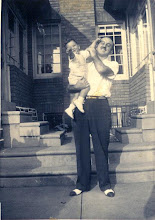
I remember a “gent” with a sterling silver cigarette holder burning a “perfect” cigarette hole in the most elegant pair of slacks I have seen to this day. A mild-mannered man popping Tums in his mouth after every meal, and in-between. A hard-working man falling asleep during movies and having a favorite song because it was the only one he knew—
if I sang “the one I like” to him, which I did at his bedside. "In a quaint caravan, there's a lady they call the gypsy." I remember a pal who blindly took my side in every squabble. I remember a tender, loving father who called me, of all things, his “pussycat.”

I remember too little, and I waited too long to learn a lot about him. My mother told me she would have to “drag” him away on vacation. Dining with him in some idyllic setting, she saw a distant look come into his eyes. “Lou,” she said, “Are you enjoying yourself?” He looked at her and, his eyes asking for mercy, said, “Do you know what I could be making now?"

My Uncle George, who worked for my father during summer breaks from college and idolized him, said he and a three or four-man entourage of my father’s co-workers would struggle to keep up with him as he hurried along a small town street, turned abruptly to enter a restaurant, stepped to the bar, ordered coffee, swallowed two sips and left as abruptly as he entered, entourage hotfooting after. An hour later, my father would do it again—the hasty turn, the restaurant bar, the coffee, the two sips, the sudden exit. And that was nothing, my uncle recalled from his youth with fresh awe, compared to the fox my father whimsically bought as a pet!

My cousin Elaine describes the excitement of the young cousins in Pittsburgh when, on the same day every week, they ran into a neighborhood grocery to see their names on the labels of the produce baskets “D. LOUIS FOX” shipped all the way from Wachula or Pompano Florida. "Elaine Peppers"… “Gloria Carrots"… “Samuel Cucumbers”!

By all accounts, he was a sweet, genteel man.

The punch and the prizes are not the same when your grandfather takes you to a father and son day.