Showing posts with label Israel. Show all posts

Thursday, June 26, 2014

Eli Wallach: The Man with the Optical Grin

It took some delicious memories of the most endearingly impish man I've ever known to get me back to this blog.

Eli in 2007, the recipient (with Anne) of the Dutch Treat Club Gold Medal for Lifetime Achievement in the Arts. 

Thirty years ago, I spent seven unholy days and nights in Israel with Eli Wallach and Anne Jackson—a long week making a short film we knew none of us would ever deserve recognition for. 

On Day One, as we entered the Tel Aviv suk [bazaar], Eli dropped back several steps and said to me, in his inimitable heartfelt whine, “I don’t know what I’m doin’ here. Annie played Lou Kaddar, Golda Meir’s sidekick, in “A Woman Called Golda”… they’ll know her!  But no one will know who I am.”

Just then, from their stalls and from behind their counters, the market’s vendors, consecutively laying eyes on him, started leaning forward, cupping their hands… and singing the indelibly haunting theme from “The Magnificent Seven.” As Eli broke into a slow grin:  bum… bum/bum/bum… bum/bum/bum/ bum/ bum/ bum....  

On Day Two, a shoot day, Eli, standing alone on a bare outdoor stage, asked me how to say a famous line of Shakespeare—in Hebrew. Cameras rolling, the dazzling Israeli noonday sun for a spotlight, he emoted: “lee-hee-yot o lo lee-hee-yot.”  To be or not to be.  Anne whispered, “Foxy, darling, does he know what he’s doing?” “That,” I failed to assure her, “is the question.”

Eli was mischievous. Anne could be… mercurial. Eli would misbehave, knowing full well his Annie would react. And every time she did, I would see this fleeting, impish, glint—a split second flicker of optical grin—flash in his eyes. Anne had to live with it; all I wanted was one shot of it, one photo.  

It cost me roll upon roll of film as I tried, unfailingly in vain, to capture this, the most classic, of their shenanigans. I fell into a pattern of standing around, camera in hand, trying not to be obvious, but perched at the ready for that glint, that unparalleled optical grin, determined to catch it, trying to anticipate it whenever I saw Eli peer anywhere but into Anne’s reproving eyes. Seeing it coming… and always missing it!  Peer Glynt, I began to call it under my breath in frustration. Click! I missed. There it is again! Click! Missed again. Click! Damn! I must have squandered four rolls of high-speed film on trying to capture Eli’s virtuoso “Peer Glynt.” Just once! I never did. I never wanted that shot as much as I do today. 


Tuesday, January 14, 2014

At Ease in the Fields of Sharon


Photo 


No one is ambivalent about Ariel Sharon. Or ever hesitant to share strong sentiments. I’ll leave it to both admirers and detractors to give you earfuls of what they want you to know about him. Here’s what I know:

"Arik" Sharon knew his beloved country Israel by the inch, every inch, conceivably and convincingly better than the proverbial back of his hand. Once, to make a point to me, he reached into his back pocket, withdrew a map of Israel he evidently always carried with him, and spread it out over the front fender of a parked car. His index finger deftly indicating spot after spot of land, he said, "We can’t give this back to them because it’s high ground they can easily attack us from… can’t let them have this because it’s directly above a road we use for civilian and military transit… can’t vacate this because a rock thrown from here can stop or kill someone." A rock! He wasn’t nearly finished, but he’d made his point—life and death in the Middle East wasn’t, as commonly perceived, so much periodic and precariously seismic as it was day-to-day, hand-to-hand, inescapably rooted in biblical times.

He was an impassioned patriot and single-minded warrior. "A tank coming through," an early but former ally of his, Geulah Cohen, memorably characterized him for me during a late-evening reminiscence at Israel’s Knesset. "He’s here, and he sees there," she pointed, "and nothing in between. He would roll over anything—even his mother, I believe—that stood in his way." 

In June, 1982, in response to the PLO’s persistent missile attacks on northern Israeli towns and a Palestinian terrorist group’s attempted assassination of Israel's Ambassador to Great Britain, the Israel Defense Forces, under then defense minister Sharon’s leadership, stormed across Lebanon’s southern border, subsequently sweeping north through Lebanon in a stunning victory over PLO, Syrian and Muslim Lebanese forces. When I asked him about the "game plan" and the "wisdom" of the show of force, he told me with boyish candor that it was not part of any strategy he had in mind, but that his forces encountered so little effective resistance from the PLO, "We just kept going." With an expansive shrug and his irrepressible smile, he explained, "We couldn’t stop!"

During the Christmas/Chanukah holidays of 1982, I accompanied Elizabeth Taylor to Israel. Prior to our departure from the United States, I promised I’d take her to Lebanon after the New Year, a prospect that particularly excited her. I would introduce her to the newly, democratically elected government officials of the country, she would be feted at the presidential palace, and, as the pièce de résistance, we would meet, possibly even ride with, Major Sa’ad Haddad, a hero of Lebanon’s Civil War and a friend.

On New Year’s Day, 1983, I was taking Elizabeth to the Sharon farm in southern Israel. We rode from Tel Aviv in the back seat of a limo, following another car while an uncustomarily hard rain continued to fall. When the lead car drove suddenly into a flooded road and slammed on its brakes, ours plowed into it. Elizabeth screamed, our bodies were thrown forward, and we wound up sprawled on the floor of the limo, her leg bleeding, a finger eerily bent, I barely able to breathe. Transferred to other cars, we arrived at the Sharons’ separately, rain-soaked and battered. He stood waiting outside under a carport for me, and lifted me out of the car as if I were weightless. "We can’t get a helicopter in the air in this weather, so a doctor is driving down from Tel Aviv," he told me. "He said to keep you warm, quiet and comfortable."

He did his best to. Blankets and brandy were administered, the fireplace stoked as ice compresses were applied. While Elizabeth, her injured leg up on an ottoman, was, by her own description, "chewing on brandy," Arik told us about the farm, i.e., we have so many acres and so many goats and so many sheep, and… and I wasn’t in any condition to pay attention. Quite soon, neither was Elizabeth. When the doctor arrived, we turned the Sharon house into a clinic. The doctor took turns examining us on the Sharon’s dining room table, concluding we had to go to the hospital—back in Tel Aviv!

Elizabeth was relegated to a neck brace, a finger cast—middle-finger upright, leg and back dressings, and a wheel chair. As Elizabeth’s landing field, I sustained a side of broken ribs. Nevertheless, we were hell-bound for Lebanon. I requested a helicopter from the general, who objected vehemently. "They will shoot the copter out of the air before it is two feet off the ground! They would love the publicity!" His "they" was the PLO. Our dialogue turned increasingly heated that evening as he, from a radio station following an interview, and I, from my hotel room preceding having to face Elizabeth, continued to debate the issue. To my astonishment, I won! Or so I believed—briefly. No sooner had I prevailed than his steadfast admonishment caught up with me. In retrospect, I think he banked on it. I informed Elizabeth that we were not going to Lebanon and braved seeing her on the brink of tears. (In due time, I will relate the droll details of most of those past 48 hours. For now, I’ll just say:) I felt caught between a rock and a hard place—and suspected that Arik represented both.

In 1983, Arik Sharon sued Time magazine for libel over a cover story alleging he had encouraged the revenge-taking that led to massacres at two Palestinian refugee camps, Sabra and Shatila, the previous year. In 1985, the day before the federal jury rendered its verdict after 11 days of deliberation, I visited his wife Lily and him in a US District Court in Manhattan as they waited in a small chamber with several others until given word there would be no decision that day. We descended the courthouse steps into nightfall to find the sidewalk and street devoid of life but for several taxis, which Arik began hailing and ushering the others into. Before he and Lily climbed into the last of them, he asked me how I was getting home. I cited subway or bus or the possibility of walking a little, but he said it was too dark and desolate, and not safe for me. I told him not to worry, "this is my city, I live here, I’m fine!" But he would have none of that. He practically shoe-horned me into a crowded taxi headed uptown.

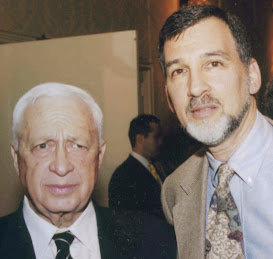
The last time I saw him was in May, 2000, at a reception in Manhattan. I may have taken the only photo with him where he wasn’t smiling. Neither of us was. An opportunity to speak quietly together had given us time to commiserate with each other: Lily had died in March and I had just lost my mother. Our conversation was respectfully interrupted by a photographer I knew from these photo-op-filled occasions. Chatting earlier in the evening with him, I mentioned the irony of not having even one photo with the general. The conscientious fellow decided to amend that before he dashed to another assignment. It wasn’t an ideal time. I posted the photo above to illustrate that.

Speaking of "an ideal time," Gilad Sharon said that his father "went when he decided to go." That was the Sharon I knew.

Thursday, May 19, 2011

Up In The Air


A novel I thought I would write many years ago culminated with a human wave of Arabs coming at Israel, shoulder to shoulder, row upon row, trance-like and unstoppable. It was fiction.

Last Sunday, thousands of Arab protesters, chiefly Palestinians, marched on Israel's borders from Syria, Lebanon, Jordan, the Egypt-Gaza line and the West Bank. We can bank on their doing it again. The Arabs have learned from Madison Avenue.

Lesson One: if you can’t sell the product, change the label. Case in point: Mad Ave legend has it that Procter & Gamble, intending to capitalize on its success with “Drene,” a shampoo, and “Dreft,” a detergent, was about to mass-market a product called “Dreck” when they discovered the word was a Yiddish vulgarism for excrement. So they changed the product’s name to “Breck.” A worldly colleague, wise in the ways of both western marketing and eastern geopolitics, contends the Arabs, unable to sell despotism or monarchy to the free world, changed the labels to “freedom” and “democracy” to bask in the media-coined “Arab Spring.” Similarly, Mad-Ave-savvy Palestinians have come to recognize that “Intifada” works better for them than “terrorist attack” and “freedom fighter” beats “suicide bomber.” By a lot.

The masses in the fictional human wave I envisioned were stoic and silent, not the mob with nary a vision for tomorrow that we behold today. For all the media hero-hailing of those who brought down Egypt’s Hosni Mubarek, I’ll remind you there are swarms of others committing un-freedom-loving acts like forcibly detaining, beating and sexually assaulting an American journalist, CBS correspondent Lara Logan; freeing criminals by facilitating jail-breaks, blatantly and crudely, while Egyptian police forces cower on the sidelines in fear of them; looting, vandalizing, downing and stripping telephone lines for copper. At what price, democracy? Freedom to what? you might ask.

I was in the Soviet Union when its head of state, Mikhail Gorbachev, gave his people a gift—two gifts!—they couldn’t dream of receiving in their lifetime: glasnost and perestroika, both of which added up to newfound freedom. And what did they do with the precious “freedom” bestowed on them? Spewed venom, blamed others for their failures, did everything but endeavor to build better lives for themselves. I observed that the gift they seized hungrily without a thank you in return was the “freedom to hate,” which gifted me with the title of the documentary I was making about them.

What I see in the “Arab Spring” is the unleashing of unrestricted forces of seething resentment and long-nurtured hatred. What I don’t see—anymore—is the spontaneity that initially had us rooting for the youthful demonstrators without judgment. I fear that those braving the blows for liberation are being cynically manipulated.

Lesson Two: apply the crafty rules of game theory, in which one individual or group does better at another's expense, conscience be damned. Brush up your Machiavelli. He who flexes the most power wins.

So, let’s see, a dictator wins until the mob displaces him. The mob thinks its winning until a mob boss emerges from the mob and takes control, leaving the mob in the dirt. It’s only a matter of time until the mob boss is replaced by another boss or emerging authoritarian. It’s a round-robin game where power unvaryingly corrupts and nobody ultimately wins. The Iranian revolutionaries overthrew the Shah and got Khomeini and the rule of the Ayatollahs. We have no idea what’s in store for Egypt, but what’s far more alarming, no one in Egypt appears to know what’s in store for Egypt. What’s in store for the region, the Middle East, the rest of the world?

Lesson three: false advertising. Since there is no oversight and no accountability, lie.

The chairman of the PLO/ president of the Palestine National Authority, Mahmoud Abbas, who gradually managed to gain the respect of outsiders, some Israelis included, just lost mine. Several weeks ago, Abbas, who convincingly professed to be a man of peace, committed himself and his political party, Fatah, to joining forces with his arch-rival, Hamas, a self-described “armed resistance” faction sworn to destroy Israel. The unimaginable reconciliation was mediated by the headless leadership of Egypt! Then, only several days ago, Abbas published an op-ed piece in the New York Times that was pure—or more accurately, impure—fiction: stating his claim for the Palestinian people, he blatantly made up his own history for them. Maybe
he should be writing a novel.

If leaders deceive their people; if they manipulate them; if they calculatingly play to win at any expense, the cheap cost of lives—others lives, of course—being the winning point; if they lie without impunity; then what is to prevent them from driving their followers, like sheep, into a ravine, or wall, or fence?

Last Sunday, the occasion for thousands of Arabs to storm Israel’s borders from five sides was the “nakba,” Arabic for "catastrophe." “Nakba” is the term they use to describe the founding of the State of Israel, or their defeat in the war on Israel, launched by five Arab nations, that immediately followed Israel's founding, or their displacement in the war—or merely the continuing existence of Israel. The Huffington Post reported, “…activists were bused in from Palestinian refugee camps throughout Syria. Many of them held European passports and told interrogators they had been flown in from abroad for the march.” And, “Many came from the 12 crowded refugee camps in Lebanon where some 400,000 Palestinian refugees live.” Clearly, the spontaneous demonstration was well organized.

What happens if “the spontaneous demonstration” is organized to become a human wave? How many lives on both sides will it take? What Abbas had to say about the Palestinian side was, "Their precious blood will not be wasted. It was spilled for the sake of our nation's freedom." That word again, freedom, used so freely it threatens to become meaningless.

As for the novel I didn’t write? I intended to leave the ending—with its relentlessly-advancing human wave—up in the air. That’s the indisputably awesome point I fear we are at in the Middle East with, but in no way limited to, the Israeli-Palestinian stalemate. Up in the air.

Tuesday, July 6, 2010

Listening for Gilad Shalit


I’m listening for two words I fail to hear: Gilad Shalit. Who? That’s my point.

My ears perk up when I hear words of particular personal interest through the din in a restaurant or other public place. “Yankees.” A certain writer’s name. “Israel.” A special song. Today’s op-ed. A name from the past. At any moment I pluck keywords out of the buzz and babel. But nowhere, at anytime, do I hear “Gilad” or “Shalit.”

Since he’s probably not part of your table talk either, permit me to tell you about Gilad Shalit. On a Sunday morning in June of 2006, Gilad, a nineteen year old corporal in the Israel Defense Forces, was abducted from an army post on the Israeli side of Gaza’s southern border by a Hamas ambush. He is thought to have suffered a broken hand and a light shoulder wound in the attack.

We’ve heard a lot about the “humanitarian” flotilla and the Gaza blockade over the past five weeks. But the
real blockade is the barely-mentioned, complete sealing-off from the world of one young prisoner of war, Gilad Shalit, by Hamas.

The International Red Cross has repeatedly requested, and been denied, access to him. The Papal Nuncio to Israel was unable to secure his release through the Catholic Church's Gaza-based parish. Egyptian mediators got nowhere with Hamas.

After two-and-a-half years of Gilad's isolation in captivity, The Deputy Chief of the Hamas Political Ministry told an Arabic daily,
“Shalit may have been wounded, and he may not have been. The subject no longer interests us. We are not interested in his well-being at all…”

The only contact Gilad has had with anyone outside his Hamas imprisoners is three letters (one to the Egyptian mediators), an audio tape released after one year of captivity, and—as a result of Israel’s fulfillment of its offer to release 20 female Palestinian detainees and prisoners in exchange for a video proving Shalit was still alive—a video shared with Israelis via television last October.

This blockade, longer by a year than the Gaza Strip’s, is anything but humane. Shalit has been imprisoned by Hamas more than four years.

As Israel Defense Minister Ehud Barak observed regarding the 1.5 million people in Gaza needing humanitarian aid, “Only one of them is locked in a tiny room and never sees the light of day, only one of them is not allowed visits and is in uncertain health”—the young captive Israeli soldier who isn’t getting it.

The same is true of attention, basic human, humane,
humanitarian attention. Google “Gilad Shalit” or otherwise search for him on the Internet—you’ll find shockingly little, especially for a young soldier whose sole transgression, in common with soldiers of every other country in the world, was serving his country. On people’s lips? Not only is “Gilad Shalit” not on their lips, but not on their minds or even remotely in their cognizance.

Not for the first time, the Israelis are faced with a governmental “Sophie’s Choice.” The “choice” in this instance is the release of some 1,000 Palestinian prisoners held by Israel in exchange for one Israeli captive held by Hamas: Shalit.
“That's the price I am willing to face to bring Shalit home,” said Israeli Prime Minister Benyamin Netanyahu six days ago.

Israel sets great store in recovering every captive. Leviticus 19:16 reads, “You shall not stand idly by the blood of your brother.
” In 1957, Israel returned some 5,000 POWs to Egypt for one Israeli pilot, Jonathan Etkes. In 1968, 4,338 Egyptian soldiers taken captive six months earlier by the Israel Defense Forces during the Six-Day War were exchanged for 11 Israeli soldiers captured by Egyptian forces. In 1985, Israel released 1,150 Palestinian prisoners in exchange for three Israeli soldiers abducted by the Popular Front for the Liberation of Palestine (PFLP). In 2008, the Israeli government voted to exchange an untold number of living Palestinian and Lebanese prisoners for the dead bodies of two soldiers who had been kidnapped by Hezbollah militants two years earlier.

I don’t hear anything like “humanitarian aid” without also hearing “Gaza,” Palestinians,” “the flotilla.” I don’t hear “blockade” without “Israel” and “outrage.” “Gilad” would catch my attention anywhere; I might hear it across Madison Square Garden. “Shalit” would resonate. I think I’d catch it whispered at a dog’s pitch. Try me.

My gratitude to Uri Dromi for many of the details in this entry.

Tuesday, June 8, 2010

A Club, A Knife, A Metal Bar, And Thou...


We’re a millennium beyond the great Persian poet Omar Khayyam extolling “A Jug of wine, a loaf of bread, and thou beside me singing in the wilderness.”

The last time I sailed the Mediterranean I didn’t say to my wife at 4 a.m., “Let’s go up on deck to look at the moon, or wait for sunrise… and bring a club and a knife with you—and a metal bar, if you have one handy."

The last time I joined a protest, I was armed with a candle. That, and what feels like a millennium of separating the wheat from the chaff since then, brings me to grapple with the grand flotilla “peace” movement.

The Israelis were mugged. Their commandos may well have turned the wrong cloud at the wrong time, but as misguided, unwarranted, over-the-top or downright foolish as their method may have been, they dropped into a trap. The do-gooders were lying-in-wait for them with open armament. As a shipboard bard might have versified wistfully after the drubbing and retaliatory fire, “A club, a knife, a metal bar, and thou beside me swinging in the wilderness.”

Let’s deal with this summarily. The Israelis blundered, hugely. But the flotilla of 546 “peaceful” activists knew what they were sailing into and what they were inviting by doing so. There’s history!—a three-year blockade; accordance with maritime law; previous flotillas intercepted; and Egypt’s co-existing blockade and independent use of force, lethal and conveniently overlooked.

Anyone desiring to stage a world-wide attention-getting event couldn’t do better. And that’s what the “humanitarians” of the six-ship flotilla wanted. According to a prior statement from their Gaza Freedom March, “A violent response from Israel will breathe new life into the Palestine solidarity movement….”

So, let’s think about this. Why does Israel have to justify inspecting the goods of six ships, or even one, from a foreign country entering its waters and bound for its shores? What country does less? What country today doesn’t have customs officers or the equivalent? What country allows anyone entry without a valid passport? What country in this day and age doesn’t have a responsibility to its citizens to protect them from harm, external or internal? The United States has a Coast Guard. And a Border Patrol. China built a Great Wall to thwart intruders from the north. Imperial Russia chose a wider gauge for its railroad tracks to prevent invasion via rail from Europe.

In 2008, a United Nations provision called for ships belonging to Iran’s state–owned Islamic Republic of Iran Shipping Lines, known as Irisl, "to be boarded and inspected at sea or in port if," according to this morning’s New York Times, “there are ‘reasonable grounds to believe’ they are carrying contraband forbidden by Security Council resolutions on Iran.” The Times’ report continues, “In three boardings, two by the United States Navy and one by Israeli commandos, authorities said they had discovered a virtual arms bazaar, including thousands of Katyusha rockets, grenades and mortar shells, believed to be intended for Hezbollah.” A virtual arms bazaar! How much evidence do Israelis, or their even-handed critics, need?

In New York City, a new Jewish Community Center deems it necessary to block its entrance with concrete posts to protect the lives and limbs of all those on its premises. I’ve yet to see a Manhattan church or mosque that has had to resort to such measures—upright reminders, sadly in particular to children attending to learn “Thou shalt love…” by Commandment and social ethics, that they are hated and randomly in danger for being what they are. Try to tell me Jews have no right to protect themselves and their children—and then, that the Israelis have no right to intercept a flotilla that may carry ill to them or to blockade an area that dispatches, by air and land, missiles, mines or suicide bombs of death, disfigurement, dismemberment and destruction.

Tuesday, April 20, 2010

In A One-Eyed World

Note: Due to technical problems of a browser’s making, many readers were unable to access the two related entries that preceded this one. The situation remedied, the following entry is intentionally briefer in hope you will read “Peace For Peace” and “Bad Timing,” preferably first.


If you know your Shakespeare, you’ll recognize this quote from Julius Caesar: The fault, dear Brutus, is not in our stars, but in our settlements. Any adherent of Taoism knows, A journey of a thousand miles begins with a single settlement. The answer, Bob Dylan fans affirm, is blowin’ in the West Bank.

I confess I almost missed it. Right there under my nose “forever” and I almost missed it. The key to all the world’s problems is the settlements! By settlements, I mean the only definition of the word in the world’s vocabulary, Israeli settlements.

Wars, famines, natural disasters, economic crisis, suicide bombings and mass murders, epidemic outbreaks and infectious diseases—all and more routinely threaten every corridor and distant corner of the earth, but the eye of the one-eyed world only brings settlements into focus.

What did we do prior to the establishment of the State of Israel? Who were the bogeymen and where on earth were they settled? What yarns did the old folks hand down to the children from cave to desert sands to rolling seas, from open fire to open porch?

Today’s tellers of tales are TV’s talking heads, parrot heads as I’ve come to think of them. They are paid—highly—to spin pap and propaganda rather than deliver news. And they know, left and right alike, no one likes settlements. It’s the dirty word they can punctuate their drivel with as much as they like without running afoul of sponsors or the FCC (in that order). You can read it on their stress-furrowed brows before they even open their mouths. Mute your TV and read it clearly on their lips: set-tle-ments. Getting rid of them would be the Second Coming. But of what?


If the Israelis flat-out stopped building settlements forever, would it bring peace on earth? Peace in the Middle East? Peace between Palestinians and Israelis?

Ask Israel’s leaders what they want and when they answer shalom, i.e., peace, they mean security. The two words are synonymous to them. Ask the Palestinians what they want until you’re blue in the face and you can’t get an answer. Peace must roll off the lips as easily in Arabic as it does in English or Hebrew, but who has heard it? Palestinian Arabs certainly know how to say jihad, intifada and shaheed distinctly, and how to indicate unequivocally what they mean by them. Know what’s Arabic for “peace”? As I thought.

With the usual arrogance of the western world, we in the United States insist on asking and expecting other peoples to think the way we do. While I’m not in favor of Israel creating more settlements, I am in favor of letting those chosen to govern do what they sincerely believe is best for the security of their people. They know now, as never before, Israel can’t rely on the United States for its survival.

Brilliant Israeli pianist/writer/government spokesman David Bar-Ilan chose his own words for peace quite some time ago: “Semantics don’t matter. If Palestinian sovereignty is limited enough so that we feel safe, call it fried chicken.”

Tuesday, April 13, 2010

Bad Timing


I’m collecting overstatements.
“Israel is rapidly destroying any chance of there being anything to talk about.”
“It was an act of hostility, antagonism, and diplomatic terrorism against its single most valuable ally.”
“The Israelis really blundered this time. The whole world is against them.”
Not so fast. When, since statehood, has “the whole world” been anything but against “them,” the U.S. on most occasions the exception? The lesson was learned in Israel early: “To be or not to be is not a question of compromise. Either you be or you don't be,” according to Golda Meir.

All right then, the announcement by Israel’s Ministry of the Interior of its intention to build new settlements in East Jerusalem, coming as it did while Vice-President Biden was in Israel to herald another go at peace via “proximity peace talks,” was bad timing. That’s all it was. It shouldn’t have surprised anyone, certainly not anyone who listens to Israel. Building Jewish neighborhoods in East Jerusalem became policy immediately following the 1967 War, a war, not so incidentally, lustily launched and resoundingly lost by Israel’s four surrounding Arab neighbor-states while “the whole Arab nation” egged them on from the sidelines. Anyone listening to Israel, including the Palestinians, recognizes its commitment to the policy and grasps the significance of the facts on the ground: the land, the neighborhoods, will remain Israel’s.

Even the timing shouldn’t be so surprising—the Israelis have made such pronouncements in the face of power often. They can’t be accused of being coy or conducting a whisper campaign; to the contrary, they want to be sure everyone knows their intentions. Say what others will—they're not guilty of tact.

The response from the media is auto-overstatement.
“Israel's Snub of Biden: More Than Just Bad Timing.”
These exact words, and the placement of the colon, resembling nothing so much as a snake’s fangs, with the words to follow hissing, “More Than Jusssst Bad Timing,” constitute at least five headlines. And that’s only in English.

So how do our diplomatic leaders, people of reason, our people of impeccable western manners, react? With snubs. With so’s your mother posturing. With mine’s bigger than yours swagger. Don’t laugh, but it starts coming down to whose snub is bigger. Is it Netanyahu’s or Biden’s? Is it Joe’s buddy, Barry, and their gal Hillary flexing hyperbole? When, oh when, do our government leaders get out of the schoolyard?

I’m on the outside looking in, witnessing the fracas and perplexed by both sides. Through the haze, I can’t help observing that for a president who doesn’t believe in not talking to your enemy to snub a time-tested good friend is bad policy, bad taste and… bad timing.

And since the subject is bad timing, let’s acknowledge, looking back on six decades of Arab-Israeli encounters, that there’s been much less fuss over much worse timing.

Leaving your house and land behind at the instruction of your Arab leadership so you and your family are out of the way while they drive all the Jews into the sea or “wipe Israel off the face of the map” is bad timing.

Premeditatedly attacking an elementary school in Ma’alot in Israel’s Western Galilee and killing 22 students in their early teens is bad timing.

Invading a nation on its people’s holiest day of the year, Yom Kippur—a day, it should not go unnoted, when those people are most likely to be reflecting on and atoning for their sins, customarily in a house of God, is bad timing.

Infiltrating Munich’s Olympic Village by night and under hoods, and using the quadrennial premier sports event as a platform to attack and terrorize, murder or take hostage, a team of young amateur athletes in their prime, is bad timing.

Hijacking an Air France airliner, directing it to Entebbe, Uganda, holding 105 Israeli’s hostage for a week and threatening to kill them unless Palestinian terrorist demands are met is bad timing. (Commander Lieutenant General Jonathan Netanyahu, the 30-year-old older brother of eventual Prime Minister Benjamin Netanyahu, was the only Israeli killed in the legendary rescue mission.)

And, possibly trumping all strictly from a political point of view, saying no to getting 96% of your demands when you represent the Palestinian people because you insist on 100%—and more, if you can pass a camel through the eye of a needle—is bad timing, and mind-numbingly self-defeating.

There you have just a few of the low points. Do you hear a rueful murmur from anywhere in “the whole world”? Neither do the Israelis.

Santayana said, "Those who cannot remember the past are condemned to repeat it." Israel’s Jews learned that lesson in history from the Holocaust. It may be the only history lesson they need. Bad timing? Someone (possibly Golda Meir) said: Better a hundred bad editorials than one obituary. Who better than those responsible for the security of the people of Israel to know that?


To be continued...

Tuesday, April 6, 2010

Peace for Peace


The United States and Israel at odds? Nah, can’t be. Must be for show, a tactical maneuver, a game-changing strategy. Right?

Either that or The President of the United States and his administration are making a bigger blunder than the Prime Minister of Israel and his cabinet.

Facts first. While the United States is promoting “proximity talks,” indirect negotiations between the Palestinian Authority and the government of Israel; while the White House expects Israel, as a unilateral trust-building gesture, to maintain a total freeze on settlement construction in East Jerusalem (with a partial freeze in the West Bank); while Vice-President Biden is visiting Israel: the coalition government of Israeli Prime Minister Benjamin Netanyahu announces eventual plans to build 1,600 new homes in an East Jerusalem settlement, Ramat Shlomo. Biden is offended, says so and returns home. George Mitchell, the U.S. special envoy to the Middle East, cancels his trip and stays home. U.S. Secretary of State Hillary Clinton and Mahmoud Abbas, President of the Palestinian Authority, are, if you know your Casablanca, “shocked… shocked.”

And President Obama, emboldened by victory after what still seems like the Thirty Years Health Care War, feeling and showing his oats, starts swaggering in the wrong direction. What is it about prioritizing that eludes him? If he wants to talk tough, he ought to be unleashing his rich rhetoric and efficacious tones on Iran or North Korea or Afghanistan’s Karzai. The Jews in his administration, all of whom must know better, should talk tachlis (“brass tacks”) to him and tell him he won’t beat little Israel into submission. It is written—in stone: David doesn’t yield to Goliath.

Let’s set aside for the moment the biblical claim to the Land of Israel, and consider the land Israel acquired in 1967 from the Six Day War after being invaded by the armies of Egypt, Jordan, Syria and Lebanon while Egypt’s President Gamal Nasser boasted, “…standing behind us are the armies of Iraq, Algeria, Kuwait, Sudan and the whole Arab nation.” If someone drove a tank into your life with the stated intent of wiping you and your family “off the face of the map,” [President Aref of Iraq], what would you be inclined to give back—as much as one rock hurled at the heads of your children? “To the victor belong the spoils” is not only a U.S. Senator’s coinage, but also exclusively a western concept in the eyes of the eastern world… when the victor is western. Now add to that the biblical claim.

So what do these intransigent Israelis want? Peace. What are they entitled to? Peace, as in freedom from attack. Peace not for land or 250 imprisoned terrorists in exchange for one captured Israeli soldier or his remains. Peace for Peace. This is what both sides, the State of Israel and the Palestinian Authority, should be asking for, demanding, agreeing to exchange and genuinely exchanging. Peace for Peace. Written in stone.

Frankly, I don’t care for Netanyahu—didn’t when I met him shortly after he came to the U.S. to join Israel's diplomatic mission here and found no reason to like him any better when, several years later, he became Israel’s Ambassador to the United Nations. Israel’s 9th Prime Minister from 1996 to 1999, he’s not the man I wanted for Prime Minister in 2009. The man I wanted is a woman, Tsipy Livni, despite her questionable claim, “…we need to give up parts of the Land of Israel.” My reservations stated, I give Netanyahu this: he’s as qualified to lead a nation as any other world leader I can think of, and far more qualified than most of them. Resolute under pressure, and eloquent in a recent address, he gets the last word today.

After citing solid evidence of a significant Jewish presence in Jerusalem and the Land of Israel 4,000 years ago, he went on to say:
“Ladies and Gentleman, the connection between the Jewish people and the Land of Israel cannot be denied. The connection between the Jewish people and Jerusalem cannot be denied. The Jewish people were building Jerusalem 3,000 years ago and the Jewish people are building Jerusalem today. Jerusalem is not a settlement, it’s our capitol.”
To be continued…

Monday, August 3, 2009

A Writer's Chronicles of a Consummate New York Writer


The subtitle of this blog asserts it will be about Broadway, Hollywood, politics or the Middle East. The following tribute covers all four topics.

Sidney Zion died yesterday of bladder cancer. Sad, but no wonder. The false lips of the world pecked away at his gut all his life and the tragically unnecessary death of his eighteen-year-old daughter essentially did him in twenty-five years ago. Anyone who knew Sidney in those days watched helplessly as he drank even harder than before, and that was going some. Never one to wallow in pity for himself or anyone, Sidney started listing and slurring in heartbreaking anger.

I could say that’s not the way I want to remember Sidney, but it wouldn’t be true—it is the way I want to remember him. The combatant, the campaigner, the debunker, the buddy.

We shared two favorite topics: Israel and songs, and by songs Sidney would poke a finger (or a glass) in the air here to tell you, “I mean the great songs, the ones they don’t write anymore.” He’d mean the songs from the great American songbook.

There wasn’t anything we could teach each other about Israel, or Zionism (how perfectly named he was, I told him), but he loved discussing lyrics with me. He could taste the fine ones. Ira Gershwin and Cole Porter would roll around on his tongue. I would quote Hammerstein and Harburg, and he would nod vigorously and beam.

Never far from quoting a good lyric, he told me he found himself alone with president Anwar Sadat on the steps of his Egyptian villa, in 1979, I believe. He asked Sadat what song he would sing when he made peace with Israel. Sadat, a bit baffled, asked what he meant. “How about Irving Berlin?" Sidney suggested. "Irving Berlin! I love Irving Berlin!" Sadat said, and, in tune now, he enthused, “Blue Skies!" Sidney pronounced it a fine song, but said he had a better “Berlin” in mind.” His choice drew an embrace from Sadat. "Let's Face the Music and Dance," Sidney recounted to me with his inimitable gusto.

It’s not surprising that he was a buddy of Frank Sinatra’s. I think the world’s greatest “saloon singer” in Sidney’s eyes saw a lot of himself in Sidney’s “boisterous candor,” author Cynthia Ozick’s perfect words for him.

Sidney told me about dining in a Manhattan restaurant with Sinatra when a woman approached their table and asked for the crooner’s autograph. As nicely and gently as he could, according to Sidney, Sinatra said he’d be happy to—as soon as he finished eating. The woman, instantly outraged, fumed, “My husband said you’d be like that!” and stormed away. Sinatra looked at Sidney and said, “You can’t win.”

Looking back at Sidney, I won. My Sid Zion shelf includes one of my favorite book titles, Trust Your Mother But Cut the Cards, and one of my favorite inscriptions to me, “If I could only spell boulavourdier, I could write the next on [sic] about Ray. Best, Sid. April 12, 1988.”

Another of his books includes one my favorite dedications, “…to Johnnie Walker, without whom none of this would have happened.”

L’chaim, Sid.

Friday, July 10, 2009

Recalling Michael Jackson

Continuing Moshe Alon’s recollections of Michael Jackson [please see the previous entry if you haven’t]:

Moshe never heard Michael Jackson raise his voice or give a command. “He was very shy,” he says, confirming widely held perceptions. At an event where Moshe wore a black tux, he heard Michael whispering softly from behind him. When he realized the words were for him, he heard Michael trying to tell him, “There’s something on your shoulder.” Had he been facing Moshe, he probably would have been silent rather than helpful.

Shy as he was offstage, when Michael Jackson was anywhere near a stage, according to Moshe, “He controlled everything. He was a showman,” says Moshe unstintingly, as if in admiration of an amalgam of P.T. Barnum and Al Jolson. During performances of super-stellar clients, Moshe is on the front line protecting them from fans who rush the stage. But Jackson selectively discouraged him from stopping them. “He let fans run onto the stage. He knew what they wanted.”

He was shy, he was savvy. He was in control or out of control.

“Other than his music and concerts, kids meant the most to him. He would take them to record stores, clothing stores, where they’d buy them up… anything they wanted.” On Jackson’s credit cards.

The kids Moshe had in mind traveled with them to Taiwan and Israel. “Kids ran around with bodyguards like kings and queens.” Moshe is critical of the parents who sent their kids unaccompanied—but for Jackson and his bodyguards—for three months. “Kids didn’t recognize their parents after that.”

As for the man whose care they were under, “He was like a child. He loved games”—so much, he had pinball games around the stage. Moshe recalled when Jackson was in group therapy. “His job was to vacuum-clean, but he didn’t know how to use a vacuum! My men had to teach him how. He went around vacuuming… vacuuming everything. He had such a good time.”

“He was not comfortable around adults. He was comfortable around Elizabeth Taylor. She understood… she was a child star too.” And the kids around him, I asked? Moshe’s answer was unequivocal. “I don’t believe he did anything wrong.”

“He trusted people.” And according to Moshe, they all took advantage of him. Not only the kids, but older people who were supposed to be friends. Not only them, but “managers and agents… anyone… everyone ripped him off.”

Moshe rented a helicopter for him for $10,000. Jackson’s representatives said, “No, Moshe, it’s $100,000.” Moshe corrected them, but they repeated the price was $100,000. Moshe told them he wouldn’t go along with them, he didn’t do things that way. They said his cut would be $20- or $30,000. When Moshe said no to them again, they said it doesn’t matter what you say, his cost is still going to be $100,000.
He said it was the same with Jackson’s doctor bills. Inflated. The same with his credit cards—they’d load charges for their own purchases on them. Those so-called friends of Jackson’s would get pills in their names to supply him with. Getting pain killers for him in places like Mexico was much easier, he added. I asked what they gained from it. “Power. And loads of money.”

Moshe says he has nothing against stars. But the people around them—“they make you sick.”

Moshe’s credibility? Elizabeth Taylor told him, “I’m never gonna ask you how I look because you tell me the truth.”

Friday, May 1, 2009

Mr. Nice Guy


Tom Hanks honored last Monday evening by The Film Society of Lincoln Center—or anytime by anyone for anything—brings back memories of time spent with a Hollywood rarity, a genuinely nice star.

I didn’t meet Tom Hanks on a Hollywood studio lot or on location. Nor was it an awards ceremony, or anywhere glamorous, that brought us together. We met in an El Al airport terminal at JFK.

I was traveling with an entourage. Tom was traveling alone. We were all bound for Israel. The star of our group was Shlomo “Chich” Lahat, dashing Israel Defense Forces General (ret.) turned dynamic Mayor of Tel Aviv (charismatic). He made the actor look like a shlepper.

Tom had just witnessed a scene more appropriate to a movie than to real life. Then New York Mayor Ed Koch had given Chich and company a police escort to the airport. That we didn’t need one was irrelevant. We arrived sirens screaming and lights flashing. The airport guards responded in kind by drawing their guns and surrounding us in a semi-circle of heightened security. As I crawled out of the second of our two cars, I nudged a slumping associate and said, “Look important—this is embarrassing.”

I had chosen this trip to take my youngest of two daughters, Haley, age 11, with me to see Israel for her first time. As we entered the terminal and took our places in line, Tom walked over to me and asked who we were.
He didn’t need an introduction, but volunteered that he was on his way to Israel to do a film.

I gestured toward the mayor, introduced my daughter, and tried to explain, as in “dispel,” the unnecessary fuss. With another gesture I said, “Come on, I’ll introduce you.”

Tom Hanks is known in Hollywood as Mr. Nice Guy. For good reason. He’s easy to know, easy to chat with. I introduced him to Chich, all the while trying to discern from Chich’s reaction if he knew who Tom was—or even had a clue he was an actor. Israeli politicians support and appreciate the arts, but I have found that most of them think show business is nonsense.

First Class travel is for American film stars, not Israeli politicians. We were in Business Class, so—different lounges for different folks—we went our separate ways.

I emerged from using the Business Class men’s room to be told by Haley that “Tom was just here looking for you. He wants us to join him in the First Class lounge.”

The only occupant of the lounge other then Mr. Nice Guy was a Hasidic Jew, who ignored us as we lounged and chatted. At one point, Tom cited his credits and Haley, who was a child actress, cited hers. At boarding time, we went our separate ways again, Tom to the upstairs of the plane, Haley and I to join our group in the forward Business Class section.

The lights were out and I was dozing when I felt a tap on my shoulder. It was Tom, who’d come down to visit. We strolled the aisles of the plane as we spoke. At one point, I paid him the only compliment I had for him. I told him how much I admired how free his acting was on a TV series I’d caught him on several times. Mr. Nice Guy modestly fielded the compliment with, “You get into a lot of bad habits in TV.”

We were whispering in a Coach Class aisle when someone stirred—a young girl. She looked up and nudged the girl next to her and heads started bobbing up in the rows of teenage girls apparently traveling together. Tom said he’d better go and retreated upstairs.

He joined Haley and me for breakfast the next morning in our mutual Tel Aviv hotel. Once again, we went our separate ways, I to my work in the city and he to his on location.

The next time I saw Tom was at the Oscars as the 62nd Annual Academy Awards ceremony concluded. Five years had passed and Haley had changed the most. She was radiant that night. Before he even got to us, I heard him excitedly telling his wife, “Rita, these are the people I told you about from the Israel trip!” I had just failed to win the Oscar I was nominated for—for Best Short Subjects Documentary—but as one of only three nominees that evening, I felt I’d already won beyond anything I’d ever dreamed. Tom put his arm around my shoulder and said, “I know what it feels like to come here and go away empty-handed.” It was such a sweet, thoughtful gesture from a remarkably sweet, thoughtful man, I had to act more disappointed than I was.

Monday, April 6, 2009

Once Upon a Passover

Robert Guillaume and I at a seder in Israel.
The photo appeared on the front page of The
Jerusalem Post twenty-five years ago.


Imagine an ethnic mix of six African-Americans, six white Anglo-Saxons, two ultra-assimilated Jews, two Latins and one Asian in Israel for Passover—all eight days of it. Food items they’d never dreamed of set before them on a dining table—not for eating, mostly for show. Symbols, like lamb shankbone, bitter herbs, salt water, charoses. And this above all: no bread in their hotel restaurant or lounge. No bread anywhere near at hand outside the hotel or on the street. An out of body-politic experience.

My partner in escorting celebrities to Israel, Shalom Elcott, and I took a host of performers to Tel Aviv to perform at a week-long children’s park festival called Medinat Hayeladim, “the children’s state.” Our incongruous troupe of entertainers consisted of Robert Guillaume (famous in Israel for TV’s “Benson”), Albert Hague (noted composer and “Fame’s” Professor Shirofsky) and his wife, actress Renee Orin, vocalist Jeree Palmer Wade, a troupe of dancers, the man and wife team responsible for the Macy’s Day balloons (that’s another story) and two necessary musicians.

One of those musicians was Robert Guillaume’s drummer, who arrived angry and left angrier. Bread—the lack of—was only the beginning of his unleavened feelings. Bob and I agreed that he couldn’t decide whether he wanted to be a drummer or a terrorist. The other musician stayed out of sight, shacked up, I suspected, with a loaf of rye.

Robert Guillaume is a good man and a gentleman. He came prepared to sing a handful of songs in Hebrew—and to sacrifice the wheat, flour and yeast. He was fine with things as they were and accepting of the things that weren’t.

Someone made the mistake of telling him he was actually fortunate because, in Israel,
Pesach (Passover) was only seven days. [The reason for the eighth day was initially the Diaspora. Given that Jewish holidays start at sundown, people far away from Jerusalem could not be certain of the day the holiday started or ended. Consequently, an eighth day was added to be sure Jews across datelines and time zones wouldn’t break leavened bread again (and wolf it down) too soon.]

So, Bob came down to breakfast on the eighth day expecting BREAD. But the hotels in Israel cater to visitors, particularly American visitors, who don’t know from seven days. “
Pesach is eight days—it’s always been eight days!”

The Israeli breakfast is famous. It consists of endless buffet tables laden with all you could ever want for breakfast, brunch, lunch, dinner, tea time and bedtime snack, plus a
nosh here and there for the rigors of the day. Without so much as a glance at the buffet tables, Bob sat down at a dining table expecting BREAD.

Guess who he was joining? Yours truly. I may have missed his “good morning,” but not his booming declaration of how much he was ready for BREAD. It fell to me to break it to him. He lost it! Completely exploded. Seven days on and off a stage in a park under the hot sun didn’t do to him what one more morning sans bread did.

Suddenly, this staid, dignified, reasonable man couldn’t separate the wheat from the chaff. He brought up grievances and frustrations I had heard nary a word of during the trip—because he never mentioned them before! Conditions at the park. Conditions in the hotel. Conditions between the park and the hotel! I tried to reason with him, but he grew hotter and hotter,
quietly fuming because, as I said, he’s a gentleman.

At this delicate point, a short, over-stuffed-looking, classic British bore of a man stopped at our table, interrupting us. He fawned all over Bob, repeating superlatives about him and his performances as he exhausted the first round of them. Robert was patient. I was barely patient—but I wasn’t jumping in the middle of this, not while someone was complimenting an actor! Finally, the man lumbered away. As if the intruder had never existed, Bob immediately turned to me and resumed his tirade. Note that neither of us has yet had a bite to eat. And there’s no
bread basket on the table.

I catch myself looking for a charitable interpretation of his tantrum. If it’s not the petite dancer from last night who was immune to his charm, I’m telling myself, it’s his blood sugar. As he’s going on and on… and on… I see none other than The British Bore, bearing heaping food dishes lined up along both outstretched arms, heading… don’t tell me!… in the direction of our table—and I know he can’t bring himself to pass it. Stopping, oblivious to the tension in the air and the glaring indication that he is intruding and unwelcome, he interrupts us again … to say to the actor—his actor of actors—“I’ve never actually seen you, but I’m sure you’re wonderful.” And continues on his way.

It changed the tune! I told Bob the line would make a great title for a book containing all the stupid things people say to celebrities (because they can’t resist talking to them and have to say something!). And we began warmly swapping stories.

Friday, February 20, 2009

WHO WAS BASHIR?


In 1981, I told Bashir Gemayel that he would be the next president of Lebanon. He shook his head and replied that his enemies would not forgive him so soon. We were both right. On August 23rd, 1982, he was elected. On September 14th, 1982, he was assassinated.

All the acclaim currently going to “Waltz with Bashir,” the frontrunner (from Israel) to win this year’s Oscar for Best Foreign Film, begs the question, “Who was Bashir Gemayel?” 

A voice-over in “Waltz with Bashir” tells us he was “a star, an idol, a prince…” Indisputable, but insufficient. An often literally nightmarish history of the 1982 Israeli-Palestinian conflict waged on the fields, streets and beaches of Lebanon, “Waltz with Bashir” is a hybrid animated documentary, a brilliant one. It is not a biography, and film has its limitations. Having known Bashir, having enjoyed an easy rapport with him and been stirred by him, I feel compelled to pick up where the film leaves off.

To meet Bashir was to be inspired by him. He was strong (to excess, according to his critics) when Lebanon, which had suffered from a history of "laissez faire-type" govern­ment, needed bold, determined leadership. He was committed: believing from the beginning of the Lebanese Civil War in 1975 that he and his people were re­sponsible not only for their own destinies, but also for the destiny of their country, Bashir gave up his law practice to become a soldier.

In beige business suit, dress shirt and tie when not in military fatigues, with boyish voice and cultured candor, he looked and sounded more like the best man at a wedding than the Commander-in-Chief of the 25,000-strong coalition Lebanese Forces and the emerging charismatic political leader on whose shoulders the future of Lebanon would barely have time to perch, much less rest.

Before he paid for his aspirations for his country with his own life, he paid a price even dearer—a car bomb intended for him took the life of his eighteen-month-old daughter, Maya. He stoically told me it was a "tribute" he was forced to pay, "the same as many Lebanese." 

A Christian Maronite who sought to be president to Christians and Moslems alike, Bashir was staunchly pro-Western, unfettered by Pan-Arabism, friendly to Israel and hostile to the Syrians and to the Palestine Liberation Organization. With his combination of intel­ligence, courage and confidence, he impressed me as having the potential to emerge not only as the leader the Arab world lacked and needed so badly, but also as a pivotal leader on the world stage. He was the only principal player in the Arab world with the imagina­tion and the courage to fill the void left by Sadat. No one since has surfaced to change that.

The details of Bashir’s death are lurid and heartbreaking. Chief of his nationalist Kataeb party, he routinely attended a weekly Tuesday afternoon meeting at a party headquarters in Beirut’s Ashrafieh neighborhood. As president-elect of Lebanon, he insisted on going “for the last time” before resigning his post. Habib Chartouni, an assassin in the employ of Syria, had family—by varying accounts, grandparents and/or a sister—living in the office’s building, where he had planted a mammoth TNT bomb. His urgent phone calls to them giving various excuses to leave the building failed—they lingered to get yet another glimpse of the beloved Bashir. Reports say the explosion lifted the building into the air before it collapsed into rubble.

No one would believe Bashir had met ill. Word spread that his attempted assassination had failed; their hero lived! Church bells pealed in celebration and soldiers fired into the air. His corpse, unearthed with many other victims, lay unidentified initially because his face was so badly crushed he was unrecognizable—until identity was established by the discovery of a nun’s letter to him in his pocket and a distinguishing finger ring. “They didn’t kill a man,” a woman is said to have screamed, “they killed a country.”

His disciples—for that in effect is what they were—were in shock and inconsolable. The voice-over of a former Israeli soldier in “Waltz with Bashir” coolly expresses, “I think they even felt an eroticism for him…. It was as if their wife had been murdered.” They took their revenge within days in the Sabra and Shatila refugee camps by massacring hundreds of Palestinian men, women and children. The Israel Defense Forces, ringing the outskirts of the camps, were accused not so much of complicity as of callous indifference. “It was obvious they’d avenge his death in some perverse way,” says the voice-over. In the waves of world-wide shock and revulsion that followed the exposure of the massacres, the think­ing world, which had barely a chance to consider Bashir when he was alive, lost sight of Bashir and never got to consider what it lost. The magnitude of his death was dismissed as quickly as his body was interred.

Lebanon is still in the hands of ill-intentioned intruders—Syria, Hezbollah and other surrogates for Iran—not the Lebanese people. Two Arab countries flanking Israel, Egypt and Jordan, enjoy peace with her—but not Lebanon. As more Arab countries recognize Israel, more Arab countries will be forced to recognize Israel—and as a consequence, be uncustomarily faced with peace. The waltz, a mournful one, continues; the band plays on.