Showing posts with label Elizabeth Taylor. Show all posts

Tuesday, January 14, 2014

At Ease in the Fields of Sharon


Photo 


No one is ambivalent about Ariel Sharon. Or ever hesitant to share strong sentiments. I’ll leave it to both admirers and detractors to give you earfuls of what they want you to know about him. Here’s what I know:

"Arik" Sharon knew his beloved country Israel by the inch, every inch, conceivably and convincingly better than the proverbial back of his hand. Once, to make a point to me, he reached into his back pocket, withdrew a map of Israel he evidently always carried with him, and spread it out over the front fender of a parked car. His index finger deftly indicating spot after spot of land, he said, "We can’t give this back to them because it’s high ground they can easily attack us from… can’t let them have this because it’s directly above a road we use for civilian and military transit… can’t vacate this because a rock thrown from here can stop or kill someone." A rock! He wasn’t nearly finished, but he’d made his point—life and death in the Middle East wasn’t, as commonly perceived, so much periodic and precariously seismic as it was day-to-day, hand-to-hand, inescapably rooted in biblical times.

He was an impassioned patriot and single-minded warrior. "A tank coming through," an early but former ally of his, Geulah Cohen, memorably characterized him for me during a late-evening reminiscence at Israel’s Knesset. "He’s here, and he sees there," she pointed, "and nothing in between. He would roll over anything—even his mother, I believe—that stood in his way." 

In June, 1982, in response to the PLO’s persistent missile attacks on northern Israeli towns and a Palestinian terrorist group’s attempted assassination of Israel's Ambassador to Great Britain, the Israel Defense Forces, under then defense minister Sharon’s leadership, stormed across Lebanon’s southern border, subsequently sweeping north through Lebanon in a stunning victory over PLO, Syrian and Muslim Lebanese forces. When I asked him about the "game plan" and the "wisdom" of the show of force, he told me with boyish candor that it was not part of any strategy he had in mind, but that his forces encountered so little effective resistance from the PLO, "We just kept going." With an expansive shrug and his irrepressible smile, he explained, "We couldn’t stop!"

During the Christmas/Chanukah holidays of 1982, I accompanied Elizabeth Taylor to Israel. Prior to our departure from the United States, I promised I’d take her to Lebanon after the New Year, a prospect that particularly excited her. I would introduce her to the newly, democratically elected government officials of the country, she would be feted at the presidential palace, and, as the pièce de résistance, we would meet, possibly even ride with, Major Sa’ad Haddad, a hero of Lebanon’s Civil War and a friend.

On New Year’s Day, 1983, I was taking Elizabeth to the Sharon farm in southern Israel. We rode from Tel Aviv in the back seat of a limo, following another car while an uncustomarily hard rain continued to fall. When the lead car drove suddenly into a flooded road and slammed on its brakes, ours plowed into it. Elizabeth screamed, our bodies were thrown forward, and we wound up sprawled on the floor of the limo, her leg bleeding, a finger eerily bent, I barely able to breathe. Transferred to other cars, we arrived at the Sharons’ separately, rain-soaked and battered. He stood waiting outside under a carport for me, and lifted me out of the car as if I were weightless. "We can’t get a helicopter in the air in this weather, so a doctor is driving down from Tel Aviv," he told me. "He said to keep you warm, quiet and comfortable."

He did his best to. Blankets and brandy were administered, the fireplace stoked as ice compresses were applied. While Elizabeth, her injured leg up on an ottoman, was, by her own description, "chewing on brandy," Arik told us about the farm, i.e., we have so many acres and so many goats and so many sheep, and… and I wasn’t in any condition to pay attention. Quite soon, neither was Elizabeth. When the doctor arrived, we turned the Sharon house into a clinic. The doctor took turns examining us on the Sharon’s dining room table, concluding we had to go to the hospital—back in Tel Aviv!

Elizabeth was relegated to a neck brace, a finger cast—middle-finger upright, leg and back dressings, and a wheel chair. As Elizabeth’s landing field, I sustained a side of broken ribs. Nevertheless, we were hell-bound for Lebanon. I requested a helicopter from the general, who objected vehemently. "They will shoot the copter out of the air before it is two feet off the ground! They would love the publicity!" His "they" was the PLO. Our dialogue turned increasingly heated that evening as he, from a radio station following an interview, and I, from my hotel room preceding having to face Elizabeth, continued to debate the issue. To my astonishment, I won! Or so I believed—briefly. No sooner had I prevailed than his steadfast admonishment caught up with me. In retrospect, I think he banked on it. I informed Elizabeth that we were not going to Lebanon and braved seeing her on the brink of tears. (In due time, I will relate the droll details of most of those past 48 hours. For now, I’ll just say:) I felt caught between a rock and a hard place—and suspected that Arik represented both.

In 1983, Arik Sharon sued Time magazine for libel over a cover story alleging he had encouraged the revenge-taking that led to massacres at two Palestinian refugee camps, Sabra and Shatila, the previous year. In 1985, the day before the federal jury rendered its verdict after 11 days of deliberation, I visited his wife Lily and him in a US District Court in Manhattan as they waited in a small chamber with several others until given word there would be no decision that day. We descended the courthouse steps into nightfall to find the sidewalk and street devoid of life but for several taxis, which Arik began hailing and ushering the others into. Before he and Lily climbed into the last of them, he asked me how I was getting home. I cited subway or bus or the possibility of walking a little, but he said it was too dark and desolate, and not safe for me. I told him not to worry, "this is my city, I live here, I’m fine!" But he would have none of that. He practically shoe-horned me into a crowded taxi headed uptown.

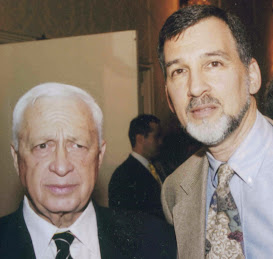
The last time I saw him was in May, 2000, at a reception in Manhattan. I may have taken the only photo with him where he wasn’t smiling. Neither of us was. An opportunity to speak quietly together had given us time to commiserate with each other: Lily had died in March and I had just lost my mother. Our conversation was respectfully interrupted by a photographer I knew from these photo-op-filled occasions. Chatting earlier in the evening with him, I mentioned the irony of not having even one photo with the general. The conscientious fellow decided to amend that before he dashed to another assignment. It wasn’t an ideal time. I posted the photo above to illustrate that.

Speaking of "an ideal time," Gilad Sharon said that his father "went when he decided to go." That was the Sharon I knew.

Thursday, March 24, 2011

Elizabeth Taylor's Nine Lives


Years ago, when a million dollars could last you a very comfortable lifetime, a mega-major literary agent offered to get me a million dollars for a biography of Elizabeth Taylor. It was an offer I knew he could back up and in all likelihood already had. He was, he professed, enamored with her. I wasn’t. I had just come back from a distant trip with her that felt even longer than it was; had weathered and survived the traveling circus that was Elizabeth and Co., the center ring steadily drawing in fast-shrinking concentric circles of fans and gawkers who threatened to suffocate us in every airport, hotel lobby and public space we entered; and I was refreshing myself in the anonymous air of my New York. In one of those lucid moments when your life passes before you, in this case the future, I couldn’t see myself spending the time on her life it would take to write a book about her. Still, my lunch host had just put a million dollar offer on the table at, where else?, the Russian Tea Room. I told him I’d been invited to be her house guest in L.A. next week and said, “I’ll ask her.”

I related the agent’s offer to Elizabeth, thinking she’d have visions of sugarplum-shaped diamonds dancing in her head and foresee many more lavender dresses and shawls hanging in her vast dress closet. After musing momentarily about it, she said, “I don’t think I’ve lived my life yet.” I laughed and said, “The way I see it, you’ve lived at least eight of them.”

It was a relief for me to come up with an alternate plan. I had come to know Elizabeth as a wonderful story teller. After we were both injured in a car accident and consequently relegated to gorging ourselves on marzipan in the presidential suite at The Tel Aviv Hilton while we recovered, I managed, with simple prompting, to get her to tell me what seemed like every story she had in her. Our afternoons were like biopics: in addition to The Mike Todd Story, The Richard Burton Story and The (briefer) Eddie Fisher Story, her cast of characters and foibles included her friendships with Montgomery Clift, Rock Hudson, royalty and roués and, get this, Anwar Sadat. Telling her I was concerned about her inevitably losing track of pertinent details of her truly singular stories, I suggested she tell me any that occurred to her I hadn’t yet heard and I would write them up. We would keep them in a drawer in her house until the time came when she was ready to tell The Elizabeth Taylor Story. She welcomed the idea. Unfortunately, her life in L.A. and mine in N.Y. being what they were, we never got to another story.

In her ninth life, she befriended Michael Jackson and stuck by him when he most needed a friend. She distinguished herself by becoming an early and leading advocate and fund-raiser for AIDS research. A genuinely good person, she used her celebrity to become an effective activist wherever she believed she could help.

Wherever she is, I’m confident she’s already embarking on life number ten.

Wednesday, December 23, 2009

In Holiday Spirit


I’m making a list and checking it twice. Because I have more envelopes than ever to fill with money this Christmas. Because I wish only half the Senate a Happy Holiday! Because Fox News’ commentator, Republican Strategist Noelle Nikpour, said the Jews “have twelve days of presents” for Chanukah—and I only lit candles (as I always do) for eight nights!

Making a list, it never occurred to me to include the worst Christmas song… until I unavoidably heard, “Oh, by gosh, by golly/ It's time for Mistletoe and Holly.” It doesn’t get better. “Tasty pheasants… overeating… fancy ties an' granny's pies.” Time, by gosh, by golly, for Alka-Seltzer.

Fa-la-la. La-la. Irving Berlin knew better than to put an oy into White Christmas. Jerry Herman didn’t write, “We Need a Little Mazel.” So how did it take three Christians—including Frank Sinatra, of all God-fearing people—to express their delirious joy to the world for “carols and Kris Kringle” with gosh and golly.

Scholars can debate the origin or actual date of Christmas, but you haven’t seen Christmas in all its contradictions until you’ve seen Santa and his reindeer on a sun-drenched lawn in West L.A. Through a tinted windshield. Imagine if the manger had been on Sunset Boulevard. Or the three wise men had followed a floodlight emanating from a Hollywood premier!

Not to be outdone this season, California’s sun-struck Laguna Beach Jews mounted a Surfboard Menorah from donated surfboards. Where there’s an oy there’s a vey.

From the ridiculous to the sublime: I spent two Christmas Eve’s in Bethlehem. That’s one more than You-Know-Who. The first time was while I was traveling with Elizabeth Taylor, whom I and two others “ditched” for the evening, left behind in a hotel suite in Tel Aviv because she was being such a pain in the ass. If you’re gonna find out who’s naughty or nice, there’s no place like the Church of the Nativity for the holidays. And if you want to go spiritual and festive simultaneously, tingly and tender and roused, Manger Square on Christmas Eve is that memorable place.

On my second Christmas Eve in Bethlehem, I helped escort cast members of “Beverly Hills 90210.” We met with the little town of Bethlehem’s Arab mayor, who had no idea who the actors were. Then they prayed—I saw them.

So this year, all I want for Christmas is national health care. Oh, and a stocking-stuffer—a Christmas sock to stuff in Joe Lieberman’s mouth.

Friday, July 10, 2009

Recalling Michael Jackson

Continuing Moshe Alon’s recollections of Michael Jackson [please see the previous entry if you haven’t]:

Moshe never heard Michael Jackson raise his voice or give a command. “He was very shy,” he says, confirming widely held perceptions. At an event where Moshe wore a black tux, he heard Michael whispering softly from behind him. When he realized the words were for him, he heard Michael trying to tell him, “There’s something on your shoulder.” Had he been facing Moshe, he probably would have been silent rather than helpful.

Shy as he was offstage, when Michael Jackson was anywhere near a stage, according to Moshe, “He controlled everything. He was a showman,” says Moshe unstintingly, as if in admiration of an amalgam of P.T. Barnum and Al Jolson. During performances of super-stellar clients, Moshe is on the front line protecting them from fans who rush the stage. But Jackson selectively discouraged him from stopping them. “He let fans run onto the stage. He knew what they wanted.”

He was shy, he was savvy. He was in control or out of control.

“Other than his music and concerts, kids meant the most to him. He would take them to record stores, clothing stores, where they’d buy them up… anything they wanted.” On Jackson’s credit cards.

The kids Moshe had in mind traveled with them to Taiwan and Israel. “Kids ran around with bodyguards like kings and queens.” Moshe is critical of the parents who sent their kids unaccompanied—but for Jackson and his bodyguards—for three months. “Kids didn’t recognize their parents after that.”

As for the man whose care they were under, “He was like a child. He loved games”—so much, he had pinball games around the stage. Moshe recalled when Jackson was in group therapy. “His job was to vacuum-clean, but he didn’t know how to use a vacuum! My men had to teach him how. He went around vacuuming… vacuuming everything. He had such a good time.”

“He was not comfortable around adults. He was comfortable around Elizabeth Taylor. She understood… she was a child star too.” And the kids around him, I asked? Moshe’s answer was unequivocal. “I don’t believe he did anything wrong.”

“He trusted people.” And according to Moshe, they all took advantage of him. Not only the kids, but older people who were supposed to be friends. Not only them, but “managers and agents… anyone… everyone ripped him off.”

Moshe rented a helicopter for him for $10,000. Jackson’s representatives said, “No, Moshe, it’s $100,000.” Moshe corrected them, but they repeated the price was $100,000. Moshe told them he wouldn’t go along with them, he didn’t do things that way. They said his cut would be $20- or $30,000. When Moshe said no to them again, they said it doesn’t matter what you say, his cost is still going to be $100,000.
He said it was the same with Jackson’s doctor bills. Inflated. The same with his credit cards—they’d load charges for their own purchases on them. Those so-called friends of Jackson’s would get pills in their names to supply him with. Getting pain killers for him in places like Mexico was much easier, he added. I asked what they gained from it. “Power. And loads of money.”

Moshe says he has nothing against stars. But the people around them—“they make you sick.”

Moshe’s credibility? Elizabeth Taylor told him, “I’m never gonna ask you how I look because you tell me the truth.”

Tuesday, July 7, 2009

Securing Michael Jackson


I never dreamed I’d be writing about Michael Jackson on this blog (or anywhere else).

I had an elderly aunt who, in the early days of television, complained that she wanted a new TV because the “old” set handed down to her only played old films. As I walked away from our kitchen TV grumbling about the round-the-clock media marathon Jackson’s death had become, I thought of Aunt Ida. Maybe I needed a new TV.

Then I thought of an old friend, Moshe Alon, a first-rate security agent who has worked with the biggest of stars and VIPs, including Michael Jackson. Based on having seen him in action, I believe Moshe is the best security man in the country, probably any country. He doesn’t wait for trouble, he anticipates and prevents it. He uses his head instead of his muscles, and I’ve never seen him with a weapon. He’s wise and sensible, ethical and unassuming. Only the most qualified security personnel are employed by his company, PSC, Professional Security Consultants, but it is Moshe who is always in demand.

Moshe and I met in Israel when I was traveling with Elizabeth Taylor and he was engaged to provide her security. He was so impressive, Elizabeth invited him to come to America to work for her. That was 27 years ago, and while his services to her were never exclusive, his loyalty to her has never flagged, so the few times she asked him as a favor to her to help Michael Jackson, he did. [That’s Moshe between them in the above photo.] And when, not as a favor but as a friend, I asked him about Jackson, he readily reminisced.

Jackson watchers will remember that when he was in rehab, he disappeared for a month. It started with Elizabeth Taylor and Moshe going to Mexico for him. Moshe detailed how he had to scramble to get Jackson’s passport from the superstar’s own security people, who were withholding it from him. Then, using the first of many decoys, Moshe put an African-American who resembled Jackson in a car headed in one direction while he and Elizabeth spirited him away in another and put him on a private plane to Iceland.

While “everyone” was looking for him, they escorted Jackson to London, where he hid more or less in plain sight, and then to Switzerland, while Moshe dispatched look-alikes “all over the place.” Jackson’s own management offered Moshe “hundreds of thousands of dollars” to tell them where Jackson was, but he wouldn’t take it.

“When he [Jackson] came back to America, he was clear in his head,” says Moshe with satisfaction.

To be continued: personal recollections of the private Michael Jackson.