Showing posts with label Lebanon. Show all posts

Tuesday, January 14, 2014

At Ease in the Fields of Sharon


Photo 


No one is ambivalent about Ariel Sharon. Or ever hesitant to share strong sentiments. I’ll leave it to both admirers and detractors to give you earfuls of what they want you to know about him. Here’s what I know:

"Arik" Sharon knew his beloved country Israel by the inch, every inch, conceivably and convincingly better than the proverbial back of his hand. Once, to make a point to me, he reached into his back pocket, withdrew a map of Israel he evidently always carried with him, and spread it out over the front fender of a parked car. His index finger deftly indicating spot after spot of land, he said, "We can’t give this back to them because it’s high ground they can easily attack us from… can’t let them have this because it’s directly above a road we use for civilian and military transit… can’t vacate this because a rock thrown from here can stop or kill someone." A rock! He wasn’t nearly finished, but he’d made his point—life and death in the Middle East wasn’t, as commonly perceived, so much periodic and precariously seismic as it was day-to-day, hand-to-hand, inescapably rooted in biblical times.

He was an impassioned patriot and single-minded warrior. "A tank coming through," an early but former ally of his, Geulah Cohen, memorably characterized him for me during a late-evening reminiscence at Israel’s Knesset. "He’s here, and he sees there," she pointed, "and nothing in between. He would roll over anything—even his mother, I believe—that stood in his way." 

In June, 1982, in response to the PLO’s persistent missile attacks on northern Israeli towns and a Palestinian terrorist group’s attempted assassination of Israel's Ambassador to Great Britain, the Israel Defense Forces, under then defense minister Sharon’s leadership, stormed across Lebanon’s southern border, subsequently sweeping north through Lebanon in a stunning victory over PLO, Syrian and Muslim Lebanese forces. When I asked him about the "game plan" and the "wisdom" of the show of force, he told me with boyish candor that it was not part of any strategy he had in mind, but that his forces encountered so little effective resistance from the PLO, "We just kept going." With an expansive shrug and his irrepressible smile, he explained, "We couldn’t stop!"

During the Christmas/Chanukah holidays of 1982, I accompanied Elizabeth Taylor to Israel. Prior to our departure from the United States, I promised I’d take her to Lebanon after the New Year, a prospect that particularly excited her. I would introduce her to the newly, democratically elected government officials of the country, she would be feted at the presidential palace, and, as the pièce de résistance, we would meet, possibly even ride with, Major Sa’ad Haddad, a hero of Lebanon’s Civil War and a friend.

On New Year’s Day, 1983, I was taking Elizabeth to the Sharon farm in southern Israel. We rode from Tel Aviv in the back seat of a limo, following another car while an uncustomarily hard rain continued to fall. When the lead car drove suddenly into a flooded road and slammed on its brakes, ours plowed into it. Elizabeth screamed, our bodies were thrown forward, and we wound up sprawled on the floor of the limo, her leg bleeding, a finger eerily bent, I barely able to breathe. Transferred to other cars, we arrived at the Sharons’ separately, rain-soaked and battered. He stood waiting outside under a carport for me, and lifted me out of the car as if I were weightless. "We can’t get a helicopter in the air in this weather, so a doctor is driving down from Tel Aviv," he told me. "He said to keep you warm, quiet and comfortable."

He did his best to. Blankets and brandy were administered, the fireplace stoked as ice compresses were applied. While Elizabeth, her injured leg up on an ottoman, was, by her own description, "chewing on brandy," Arik told us about the farm, i.e., we have so many acres and so many goats and so many sheep, and… and I wasn’t in any condition to pay attention. Quite soon, neither was Elizabeth. When the doctor arrived, we turned the Sharon house into a clinic. The doctor took turns examining us on the Sharon’s dining room table, concluding we had to go to the hospital—back in Tel Aviv!

Elizabeth was relegated to a neck brace, a finger cast—middle-finger upright, leg and back dressings, and a wheel chair. As Elizabeth’s landing field, I sustained a side of broken ribs. Nevertheless, we were hell-bound for Lebanon. I requested a helicopter from the general, who objected vehemently. "They will shoot the copter out of the air before it is two feet off the ground! They would love the publicity!" His "they" was the PLO. Our dialogue turned increasingly heated that evening as he, from a radio station following an interview, and I, from my hotel room preceding having to face Elizabeth, continued to debate the issue. To my astonishment, I won! Or so I believed—briefly. No sooner had I prevailed than his steadfast admonishment caught up with me. In retrospect, I think he banked on it. I informed Elizabeth that we were not going to Lebanon and braved seeing her on the brink of tears. (In due time, I will relate the droll details of most of those past 48 hours. For now, I’ll just say:) I felt caught between a rock and a hard place—and suspected that Arik represented both.

In 1983, Arik Sharon sued Time magazine for libel over a cover story alleging he had encouraged the revenge-taking that led to massacres at two Palestinian refugee camps, Sabra and Shatila, the previous year. In 1985, the day before the federal jury rendered its verdict after 11 days of deliberation, I visited his wife Lily and him in a US District Court in Manhattan as they waited in a small chamber with several others until given word there would be no decision that day. We descended the courthouse steps into nightfall to find the sidewalk and street devoid of life but for several taxis, which Arik began hailing and ushering the others into. Before he and Lily climbed into the last of them, he asked me how I was getting home. I cited subway or bus or the possibility of walking a little, but he said it was too dark and desolate, and not safe for me. I told him not to worry, "this is my city, I live here, I’m fine!" But he would have none of that. He practically shoe-horned me into a crowded taxi headed uptown.

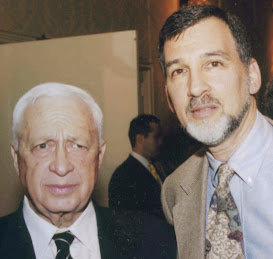
The last time I saw him was in May, 2000, at a reception in Manhattan. I may have taken the only photo with him where he wasn’t smiling. Neither of us was. An opportunity to speak quietly together had given us time to commiserate with each other: Lily had died in March and I had just lost my mother. Our conversation was respectfully interrupted by a photographer I knew from these photo-op-filled occasions. Chatting earlier in the evening with him, I mentioned the irony of not having even one photo with the general. The conscientious fellow decided to amend that before he dashed to another assignment. It wasn’t an ideal time. I posted the photo above to illustrate that.

Speaking of "an ideal time," Gilad Sharon said that his father "went when he decided to go." That was the Sharon I knew.

Thursday, October 29, 2009

A Marathon Remembered


The 2009 New York City Marathon is this Sunday, November 1st.


I remember it as a crisp fall Sunday turned dark, an eerily unsteady day for a marathon. The day was October 23, 1983.

Author and leading animal rights activist Cleveland Amory had, in his inimitable fashion, not asked, but told me I was coming to “a little party” he was giving in his Central Park South apartment, which “practically” overlooked the finish line of the New York City Marathon.

I arrived to find Cleveland’s cozy living room, too small I believed to contain the larger than life Cleveland, filled with “big” people: Walter Cronkite, Arthur Schlesinger, Norman Mailer and Walter Anderson, the Parade Magazine chief. I was immediately informed that the U.S. Marine barracks in Lebanon had been attacked by a terrorist suicide truck bombing, killing 241 marines.

I was asked questions I wished I had answers for—I was supposed to be an authority on Lebanon—but I was as uninformed and bewildered as everyone else. You don’t venture guesses when it’s Walter Cronkite who’s doing the asking.

Cleveland had engaged a chef to prepare omelettes to order, but no one was eating. No one was interested in anything but the heartrending news. The venerable newsmen seated themselves around a television set to catch what updates they could. They talked about switching channels briefly to look in on the marathon—which one could view “live” from Cleveland’s balcony, a dozen steps away—but stayed glued to their seats and the network news. In reality, no one on TV knew enough of anything yet, and the reports became a litany of hearsay and conjecture. If you take news as something new, there was none.

Only Mailer and I took to the tiny balcony, which overlooked the final stretch immediately before the marathon’s finish line. Smitten by the display of the runners’ stamina, I said, “Look at that, Norman… 26 miles, and they look fresh as they can be!” He said, “That’s because they’re losers.” As my jaw dropped, he added, “It’s a race. They should be all out.”

Tuesday, September 29, 2009

Lebanon, the Film


This is not a review, it is a recommendation. This Thursday and Friday, October 1 and 2, the New York Film Festival will be presenting Lebanon, a feature film that takes us—by tank—into the first 24 hours of the 1982 Lebanon war, i.e., when Israel’s troops entered Lebanon in pursuit of the PLO. For anyone who thinks war is anything less than horrific, or possibly that there is something heroic about sending young people into it, this film is obligatory.

Via one tank, one day and five soldiers, the director captures the claustrophobia and terror of the dank interior of an Israeli battle tank.

This tank stalls in war, gets lost, runs amok. It takes a hit, it takes on a captured, wounded Syrian soldier. “Treat him good,” an Israeli officer says, “He’s a war prisoner.” The tank’s driver panics, its gunner freezes at the sight of his first target, closes his eyes as he fires at the second one. Its commander has trouble controlling his men.

His men are boys. One asks a superior officer to call his home and let his mother know he’s all right.

None of this is the stuff of screenplays. In Lebanon in 1982, I saw a sign instructing Israeli soldiers to do just that. “Call Home. Call Your Parents—At Every Opportunity.” Such signs appeared with telephones installed along the Israeli-Lebanon border.

While I spoke with soldiers on Lebanon’s coastal road outside Damour, I kept an eye on a friend, a seasoned woman who was a prominent Israeli journalist, as she spoke softly with a young soldier. In the day’s twilight, I saw him help her up and then help her lower herself into a tank similar to one her son had died in during the Fourth Arab-Israeli War, the “Yom Kippur War” of 1973. When she emerged, not more than five minutes later, she seemed calmer than she had been all day. “Go ahead,” she said as she approached me, “Ask your question.” She was right, I had one. “How do you deal with it?” I asked gently as I could. She answered, “If you don’t, you go mad. Yes, I think you must go mad.”

Lebanon, an Israeli film directed by Samuel Maoz. Alice Tully Hall, Broadway at 65th Street. Thursday, October 1 at 9:30 p.m. and Friday, October 2 at 3 p.m.

Monday, June 8, 2009

On Entering Lebanon

As I anxiously await news of Lebanon’s bitterly-contested Parliamentary elections, concerned that history—primed to repeat its obstinate self—will once again rouse the beast of the country’s sectarian rule and lead to renewed violence, I reflect on an answer to a question so many have asked me: how did you get so involved with Lebanon?
- - -

My curiosity, more than anything, landed me in war-torn Lebanon in 1980. I had read that a Lebanese Army major, Sa’ad Haddad, had defected to form his own militia in southern Lebanon—and he, a Christian Arab, had allied himself with the Israel Defense Forces. I wanted to know why.

I crossed mined roads, war zones and hostile checkpoints to get a credible answer from Haddad, himself: to rid his native soil of the encroaching Palestine Liberation Organization and the occupying Syrians, infiltrating predators who were destroying his country and pursuing his people’s extinction. I thought I was in relatively hot pursuit of him, but he walked in on me—late at night and all of a sudden—in the alcove of what wouldn’t pass for a hotel elsewhere. Paltry press accounts and political scuttlebutt had prepared me for a hothead, a warrior, so I must have had some cross between Douglas MacArthur and Genghis Kahn in mind as I initially mistook the unimposing figure in combat fatigues and dirty boots for his intermediate lackey. The man I sat down with—can this be Haddad?—was burdened, weary and plainly sad. No airs, no histrionics. As I would discover, a peasant-patriot. He interrupted the interview to say, “You ask interesting questions.” In time, I became his confidant and unspoken friend. He took me to his house, just dirt road steps across from the house he’d been raised in, to show me his bullet-riddled walls—just above his reading chair… inches from where his wife and children dined… closely splayed over the family’s only toilet.

I entered Lebanon as often as I could. I would run into Haddad and his odd lot of soldiers on a nameless dirt road anywhere, whereupon he would bring his jeeps or tanks to a halt and find a place for us to chat privately. I would lean toward him and say, “Come on, level with me,” and inwardly marvel that he would. Once, he borrowed a house, its occupants honored to vacate quickly as we took over their kitchen.


I was distracted by the rumble of tank engines idling outside and said, “I feel like I’m holding up the war.”

The course of my life took an abrupt turn. While in Lebanon, I could feel everyone—from Haddad’s band of men through Israeli, Lebanese and Arab troops to multi-national United Nations peacekeeping forces—wondering, “Who is this man?” In little time, people began to see me as the Middle East expert I was swiftly becoming: welcome mats (and rugs) were spread out for me, while in the States, my accounts and viewpoints appeared in major publications and in the U.S. Congressional Record, and I appeared on TV and radio, and addressed large gatherings, always alerting audiences to, imploring them to prevent, a Christian genocide.

Did anything I said make a difference? Save lives? Spare any part of the Christian community? Haddad later told authorities that I “turned it around” for him.

Israeli troops were gathering on Lebanon’s southern border. The military, led by General Ariel Sharon, planned to enter southern Lebanon to stem the PLO’s missile attacks on northern Israeli towns. When it did (1982), it rolled north through Lebanon. Sharon, whom I came to know well, told me with boyish candor that it was not part of any strategy he had in mind—but that his forces encountered so little effective resistance from the PLO, they just kept going. With an expansive shrug, he explained, “We couldn’t stop!”

As the PLO fled north, and soon to Tunis, the Lebanese started taking their country back. They elected a president, a cultured, charismatic 34-year-old Christian Maronite, Bashir Gemayel, who didn’t live to take office.


[If you haven’t read the February 20th, 2009 entry on this blog, please click on “Who Was Bashir?” or scroll down.]

Friday, February 20, 2009

WHO WAS BASHIR?


In 1981, I told Bashir Gemayel that he would be the next president of Lebanon. He shook his head and replied that his enemies would not forgive him so soon. We were both right. On August 23rd, 1982, he was elected. On September 14th, 1982, he was assassinated.

All the acclaim currently going to “Waltz with Bashir,” the frontrunner (from Israel) to win this year’s Oscar for Best Foreign Film, begs the question, “Who was Bashir Gemayel?” 

A voice-over in “Waltz with Bashir” tells us he was “a star, an idol, a prince…” Indisputable, but insufficient. An often literally nightmarish history of the 1982 Israeli-Palestinian conflict waged on the fields, streets and beaches of Lebanon, “Waltz with Bashir” is a hybrid animated documentary, a brilliant one. It is not a biography, and film has its limitations. Having known Bashir, having enjoyed an easy rapport with him and been stirred by him, I feel compelled to pick up where the film leaves off.

To meet Bashir was to be inspired by him. He was strong (to excess, according to his critics) when Lebanon, which had suffered from a history of "laissez faire-type" govern­ment, needed bold, determined leadership. He was committed: believing from the beginning of the Lebanese Civil War in 1975 that he and his people were re­sponsible not only for their own destinies, but also for the destiny of their country, Bashir gave up his law practice to become a soldier.

In beige business suit, dress shirt and tie when not in military fatigues, with boyish voice and cultured candor, he looked and sounded more like the best man at a wedding than the Commander-in-Chief of the 25,000-strong coalition Lebanese Forces and the emerging charismatic political leader on whose shoulders the future of Lebanon would barely have time to perch, much less rest.

Before he paid for his aspirations for his country with his own life, he paid a price even dearer—a car bomb intended for him took the life of his eighteen-month-old daughter, Maya. He stoically told me it was a "tribute" he was forced to pay, "the same as many Lebanese." 

A Christian Maronite who sought to be president to Christians and Moslems alike, Bashir was staunchly pro-Western, unfettered by Pan-Arabism, friendly to Israel and hostile to the Syrians and to the Palestine Liberation Organization. With his combination of intel­ligence, courage and confidence, he impressed me as having the potential to emerge not only as the leader the Arab world lacked and needed so badly, but also as a pivotal leader on the world stage. He was the only principal player in the Arab world with the imagina­tion and the courage to fill the void left by Sadat. No one since has surfaced to change that.

The details of Bashir’s death are lurid and heartbreaking. Chief of his nationalist Kataeb party, he routinely attended a weekly Tuesday afternoon meeting at a party headquarters in Beirut’s Ashrafieh neighborhood. As president-elect of Lebanon, he insisted on going “for the last time” before resigning his post. Habib Chartouni, an assassin in the employ of Syria, had family—by varying accounts, grandparents and/or a sister—living in the office’s building, where he had planted a mammoth TNT bomb. His urgent phone calls to them giving various excuses to leave the building failed—they lingered to get yet another glimpse of the beloved Bashir. Reports say the explosion lifted the building into the air before it collapsed into rubble.

No one would believe Bashir had met ill. Word spread that his attempted assassination had failed; their hero lived! Church bells pealed in celebration and soldiers fired into the air. His corpse, unearthed with many other victims, lay unidentified initially because his face was so badly crushed he was unrecognizable—until identity was established by the discovery of a nun’s letter to him in his pocket and a distinguishing finger ring. “They didn’t kill a man,” a woman is said to have screamed, “they killed a country.”

His disciples—for that in effect is what they were—were in shock and inconsolable. The voice-over of a former Israeli soldier in “Waltz with Bashir” coolly expresses, “I think they even felt an eroticism for him…. It was as if their wife had been murdered.” They took their revenge within days in the Sabra and Shatila refugee camps by massacring hundreds of Palestinian men, women and children. The Israel Defense Forces, ringing the outskirts of the camps, were accused not so much of complicity as of callous indifference. “It was obvious they’d avenge his death in some perverse way,” says the voice-over. In the waves of world-wide shock and revulsion that followed the exposure of the massacres, the think­ing world, which had barely a chance to consider Bashir when he was alive, lost sight of Bashir and never got to consider what it lost. The magnitude of his death was dismissed as quickly as his body was interred.

Lebanon is still in the hands of ill-intentioned intruders—Syria, Hezbollah and other surrogates for Iran—not the Lebanese people. Two Arab countries flanking Israel, Egypt and Jordan, enjoy peace with her—but not Lebanon. As more Arab countries recognize Israel, more Arab countries will be forced to recognize Israel—and as a consequence, be uncustomarily faced with peace. The waltz, a mournful one, continues; the band plays on.