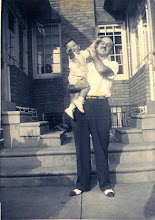
Wednesday, September 1, 2010

Dodger, the Joint-Custody Dog


When a day starts with the New York Times declaring, “Today, record-challenging heat…” no good can come from adding more heat to it. So, I’m eschewing all public and personal reflections for another week and extending the Dog Days.

Just when you think you think you can’t bear to wipe your wet brow one more time, a cooling breeze wafts across your forehead in the form of—what else?—a lovely story. Since Dodger, pictured above, is not shaggy, and his story, so far as we know it, is not long, this is anything but a shaggy dog story. Dodger, rescued from a pound, is a survivor in joint custody.

Adrienne Albert is a contemporary American composer who loved and lost a dog named Mahler. Mahler, a fawn-colored greyhound, used to sit—cross-legged—on Adrienne’s sofa without budging an inch to make room for anyone else on it. We’re not supposed to speak ill of the dead, but I didn’t approve of Mahler’s manners. He could tell, and could be quite surly about it.

Adrienne longed for, more accurately pined for, a new dog. Her neighbor, Stephanie Burns, rescues dogs and finds homes for them. Stephanie, a truly devoted “dog person” in Adrienne’s admiring eyes, found Dodger at the pound, and not a moment too soon, because he was slated to be put down the next day.

Stephanie did what Stephanie habitually does—brought him home with her to place him with a good family. But Dodger, as you will see, has a way with women. After spending just a wee bit of time with him, Stephanie fell in love, so in love she couldn’t bear to part with him. She decided she would keep him.

Stephanie has two other dogs, one she’s unable to find a home for because he, Buster, has a personality disorder, no doubt from being a dog who needed rescuing, the other, a wonderful beagle named Molly.

Scheduled to be away from home for a month and knowing how Adrienne craved another dog, Stephanie asked Adrienne if she would like to take Dodger for part of the time. Would she! In the time it took Adrienne to say “Yes!” twice, she fell in love with him.

In the course of her bliss-time, Adrienne, aware Stephanie was coming home, asked if Dodger could spend the night. (This begins to sound like a French film.) Stephanie, a modern woman, said she’d already sent Adrienne an e-mail to that effect, namely, suggesting they could share Dodger. They assumed Dodger’s swagger-the-tail complicity.

The result: the two women have the doggonedest of all worlds. Joint custody of Dodger. By day, he lives with Adrienne, who composes at home and often goes out at night. By night, he’s Stephanie’s, whose schedule is the reverse. At the beginning of every week, Adrienne sends her 7-day schedule to Stephanie, who comes to pick Dodger up for several hours each day and brings him back before his bedtime, which is substantially earlier than Adrienne’s, but Dodger is either none the wiser or very cool about it. Before long, conversely, when Adrienne will be traveling, Stephanie will be spending more quality daytime with the happily bi-domiciled Dodger.

It’s all in a Dog’s Day and it’s happening in Los Angeles. Stephanie hopes it will spur additional ways for people to adopt dogs. Citing an existing “huge” animal overpopulation problem, she emphasizes, “If people can work out a joint custody situation, then more dogs can be saved.” Now doesn’t that warm your heart and cool your brow at the same time?

Tuesday, August 24, 2010

Treading the Last Waters of August


In Ancient Rome, the Dog Days extended from July 24 through August 24, still the case, according to Wikipedia, “in many European cultures.” Not many Romans in sight these days, but maybe it’s purely cultural that so many French, Italians and Germans come to New York to suffer weather New Yorkers flee to France and Italy (but not Germany) to avoid.

No one in his or her right mind would have opted for the stifling, roasting summer of 2010 here. If the French had a word for it, it was yuch. On this day after the Dog Days, I recall sweltering in better New York circumstances….

I was ten minutes away from meeting a friend at “Alice's Tea Cup" (one of my two daughters’ three restaurants, I relate with pride) on a late August afternoon when my elevator went dark and came to a standstill. I used the light on my cell phone, its battery already low, to find the alarm on the panel. I hoped to let someone know I was trapped, but the alarm was as dead as the lights and the fan. The air in the elevator grew stifling. I began to peel off one layer of clothing at a time, folding and stacking each new article neatly beside me on the elevator’s leather bench, where I had resignedly seated myself in darkness, envisioning being discovered, eventually, flashlights shining on my dank, naked body. I imagined the woman waiting for me—an Ambassador, to make me feel worse—thinking I’d knavishly stood her up. I mused over a scene from “Sweet Charity” where Charity and her high-strung beau are trapped in a stopped elevator, and he reads a sign that says, “Capacity: 2000 pounds” and, in a panic, cries, “I weigh 163, how much do you weigh?!”

Trying to preserve my battery for an ultimate emergency, I sporadically dialed and finally reached our doorman, just long enough to learn from him that it wasn’t the elevator alone, nor the building, lacking electrical power—it looked like it could be Manhattan’s entire Upper West Side, possibly the East Coast, that was effected. It was more than plausible; I’d been through this East-Coast-blackout-thing before (which reminds me of another, salacious, only-in-New York story I don’t know you well enough to tell—yet.)

Hours later, I heard voices calling to me. My rescue squad had arrived; I didn’t care what took them so long. “Can you find…” and they described two locks or latches on the elevator doors. I used the scintilla of battery power remaining to search, grope… and find them, as the phone-light dimmed and died. Following shouted instructions, I released the contraptions and… is this madness?... opened the doors! Into pitch darkness. “You have to jump,” a voice instructed, adding
sadistically, I thought“from the elevator.”

Now I have to interrupt myself to tell you that many years ago an actress-friend was downtown at a city building stepping off an elevator when it abruptly moved, and she was cut in half. The memory, when I allow myself to have it, haunts me. “Jump?” “Yes!” Into a black hole. I took a deep breath, braced myself… and, ready to absorb the painful shock that would shoot through my legs when I landed… jumped! And landed softly, immediately, less than a foot below. I stood there stupidly, not knowing what came next. A door opened, the only door on the floor, and a housekeeper stood waiting for me to enter. Sting’s housekeeper. Sting’s apartment. Behind her, an anxious doorman and super. We passed through Sting’s apartment, past his row of mounted guitars—which, I have to say here, I’ve seen in a better light. The rear, service staircase being the only entree by stairs to our apartments at present, I exited Sting’s back door and slowly climbed the five unlit flights to mine—this was so distinctly unglamorous, so mundane now—and knocked at my back door. My wife, Jean, monitoring news of the blackout by portable radio in a kitchen lit dimly by a battery-operated lamp, opened the door, surprised to see me. She had no idea that I had been in our building—been in our elevator—no more than 75 feet away the entire time.

Tuesday, August 17, 2010

Unshakeable


I’ll be frank. I’m a Jew and I’m not looking to take an Arab to lunch.

My wide circle of friends doesn’t include one Muslim. I had a Pakistani doorman I got along with so well I would jokingly inform him we were keeping an eye on him, warn him I could have him deported faster than he could say Allah akbar and offer him a cupcake at noon “to celebrate the first day of Ramadan.”

I’ve rubbed shoulders with Muslims throughout the Middle East and at the UN, and rubbed the PLO’s most prominent Palestinian in America, Edward Said, the wrong way. I’ve had better relations with Baha’is, Buddhists and Coptics.

So, when I support the right and the propriety of Muslims to create and maintain a place for prayer, i.e., a mosque, anywhere in The United States, it’s not for them—it’s for us.

I do so with some reserve, even with trepidation. Conceivably, a mosque could be a mask for ill. But we have to take that chance. Not to do so would be tantamount to treason for all we stand for. All we profess to stand for.

That would start and end with freedom. Not freedom in the abstract, not freedom in slogan or song, not even freedom as our bromidic birthright—but the freedom we uniquely enjoy as citizens of The United States, freedom we are granted, freedom we are remarkably entitled to—by right and by law, by tradition, precedent and practice—specifically by the First and Fourteenth Amendments of The Constitution of The United States.

Setting The Constitution, the flag and apple pie aside for a few minutes, let’s examine this polarizing, complex state of affairs in simple English, a language that pols, pundits and some plain fools are cynically unwilling and seemingly unable to speak.

The mosque at Ground Zero that everyone is so emotionally-charged about is only one facet of a 13-story community center containing a mosque. It will also include offices, meeting rooms, a gym, swimming pool and basketball court, facilities for lectures, forums and weddings, and a performing arts center.

Simple. A community center. Not on Ground Zero, but two blocks from Ground Zero. Two blocks from the “hallowed land” self-righteous and self-serving knee-jerks-with-opinions have self-hallowed. Land only the families of the 3,000 victims (victims, not “martyrs”), not politicians or pundits, have any right to sanctify, and, unless they’re entitled to wear vestments, only totemically at that. Not to overlook that in Manhattan, two blocks away is a good distance from anything.

Ten blocks from Ground Zero is a narrow, two-story mosque that has yet to alarm or rile anybody. It was founded 25 years ago by Feisal Abdul Rauf, the Imam whose American Society for Muslim Advancement intends to build the disputed community center. Even closer, a mere four blocks from Ground Zero, is a basement-level mosque founded 40 years ago. Not only do both mosques predate 9/11 by a great many years, but also, the latter preceded the Twin Towers by several.

Not so simple in the hearts and minds of demagogues and dogmatists. “A mosque steps from Ground Zero,” according to the topography of The New York Daily News. Forewarns The New York Post “…where there are mosques, there are Muslims, and where there are Muslims, there are problems."

An opportunity for an opportunist to weigh in. House Minority Leader John Boehner said the decision to build the mosque wasn't an issue of law, “whether religious freedom or local zoning,” but a matter of respect. So, a man sworn to uphold the Constitution of The United States of America puts “respect for a tragic moment” before law or the Constitution—in an election year.

Not to be out-voiced (in an election year), national Tea Party leader Mark Williams objected to the mosque by declaring that Muslims worship "the terrorists' monkey god." Does anyone care what manqué 2012 GOP presidential candidate Newt Gingrich had to say? Just as I thought.

Article I, Section 3 of The Constitution of The State of New York declares: “The free exercise and enjoyment of religious profession and worship, without discrimination or preference, shall forever be allowed in this state to all humankind…” That is in addition to the inalienable rights guaranteed by the First and Fourteenth Amendments of the Constitution of The United States. We have the categorical manifesto of the President of The United States: “This is America, and our commitment to religious freedom must be unshakable.”

I don’t believe you stand for any policy or principle in part. You either stand for something or you don’t. The men who wrote The Constitution put religious freedom first among The Amendments for a reason. It might not coincide with my choice, if given one, but I’ll stand by it confidently, and, come to think of it, proudly.

With similar logic, and passion, I feel I have no choice but to support the right of The American Society for Muslim Advancement to build its mosque where it chooses—in spite of doubts that it may be ill-advised. “This is America…”

"Unshakable" is absolutely right; it can be no other way.

Tuesday, August 10, 2010

The Sidewalks of New York


Rutted and cracked, stained with gum and takeout and tears, pounded by wayfarers, dancers and do-nothings, still, something in our pavements glitters—not with gold, as myth would have it, but with essence, as New York theology would confirm. Eau d’ ordeal, tincture of rush, elixir of anecdote. The Sidewalks of New York.

Everybody has a story. A scam, a mugging, a hustle. And, unsurprisingly, every story has a punch line. Why squander a good misadventure?

An elderly Jewish woman told me of exiting El Morocco years ago when an armed man emerging from the shadows warned her, in her words, “I have here such a big gun.” My daughter’s friend, Clement Hill, reacted to news of Lauren’s mugging by commenting on Facebook that he “didn't realize that mugging was still ‘a thing’… seems so 1980s,” then added, “I hope you told him he was being very passe." (That’s two punch lines!) Another friend, screenwriter Richard Potter followed with, "I barely touched you. You fell on your own."

I reported a new hustle weeks ago by a man who no doubt retrieved a container of food from a trash basket and worked his way up the street with it, deliberately running into people as if they weren’t looking where they were going, letting his ever-dwindling portion of food thud to the ground and then guilting his victims into compensating him with cash for a new meal.

Muggers aren’t noted for their humor, but scammers—you bet! Just last week, a perfectly average-looking man in his 30s, gesturing toward a nail salon with a quickie massage table visible through its storefront window, asked me from ten feet away, “Can you pay for me to get a massage in here?” When I shook him off, he called, “I’ll let you watch the expression on my face while I get it.”

My friend, raconteur Herb Graff, would have given him $10 for that line. That’s what Herb gave a panhandler who asked for $10 for “A down-payment on my co-op.” That’s what he gave the one soliciting money for “The United Negro Pizza Fund.”

Writer Tom Bisky describes a scammer who was, “and still is, in a class by himself. Ten years ago, on a corner of Rockefeller Plaza, he somehow managed to sell me a ‘free’ baseball cap for $10. I don't remember a single detail of his spiel. I just recall thinking that ten bucks didn't seem all that much for a sturdy-seeming baseball cap. Plus, I really wanted to get away from the guy, so it amounted to ‘hush’ money I was glad to pay. Today, if I were put in charge of giving a lifetime achievement award to New York's most brazen, balls-out scammer, he would win hands-down. From time to time, I pass the same Rock Plaza corner—and he's still there, with his baseball caps in hand. For at least a decade, he's been scamming royally at one of the nerve centers of New York tourism. In fact, he's a ‘nerve’ center unto himself, because he's never more than a few yards from one (or more) of New York's Finest. So, if any of us ever really gets this guy's number, we should retire it. Among Gotham's major-league scam artistes, he's like Ruth and DiMaggio rolled into one.”

Perhaps a sociologist could explain why crowds in our city dependably make a story better. Cindy Bigras relates that she was pick-pocketed on Madison Avenue during her lunch hour. When she caught the culprit and seized her wallet back, passersby “started bitching at me” for slowing down the foot traffic.

Linda Amiel Burns drew a better-natured crowd. “In the days when Bloomingdale’s had revolving doors, a man with a green raincoat pushed himself into my section, and in a split second I could feel that my handbag was lighter, reached into it and found my wallet was gone. The mugger had a partner who tried to steer me in another direction, but I saw the green raincoat and ran after the guy like an obsessed maniac. A crowd began to follow me as I kept screaming, "Give me back my wallet!" It did occur to me that he could turn around and shoot me, but nothing was going to deter me at this point. This guy represented every man who had ‘done me wrong,’ and I was crazed and kept running after him. Suddenly, he turned around, threw the wallet at me, and ran off. And the crowd cheered and applauded.”

And why not? It’s street theater. On the Sidewalks of New York.

Tuesday, August 3, 2010

The Bilderbergers?


Many years ago, striding through Times Square in the early daylight following an all-nighter, my eyes were drawn to three stocky men seated at a bare table in a vacant, unlit Broadway cafeteria. Through a smudged plate-glass window, they looked as if they had the weight of the world on their shoulders. In my eyes, attending church was clearly not on their agenda. I mused aloud to a companion that these three men met at dawn every Sunday morning to decide the fate of the world for the week. That’s as close as I’ve ever come to having a conspiracy theory.

Now I have the Bilderbergers to ponder. Never heard of them? Of course not—that’s the point. They hide in plain sight.

The Bilderbergers are not a radio couple like the Bumsteads or Bickersons. They are members of a global elite who gather once a year behind secured doors to discuss the weighty global issues of the future. The present is already past history to them.

The Bilderbergers’ first conference was held in 1954 at the Hotel de Bilderberg, in Oosterbeek, the Netherlands. Choosing anonymity almost to the point of pathology, they are named, presumably by themselves, after real estate. Hence, The Bilderberg Conference, The Bilderberg Group, The Bilderberg Club, the aw, shucks, just folks Bilderbergers!

Just folks like Queen Beatrix of the Netherlands, Queen Sofía and King Juan Carlos I of Spain, Prince Phillip, Duke of Edinburgh, and Prince Charles of Wales. American folks like Presidents Gerald Ford, Bill Clinton and Barack Obama. Henry Kissinger, Colin Powell, Condoleezza Rice and Hillary Clinton. Senators John Edwards, Tom Daschle, Chuck Hagel and Sam Nunn. And current Governors Rick Perry of Texas—and, according to the record, Governor Mark Sanford of South Carolina, present in Chantilly, Virginia in 2008. Or was he in Argentina?

Initially, the Bilderberg Conference organizers fashioned their invitational list to include two participants from each nation, one to represent a conservative viewpoint and the other, a liberal perspective. To this day, attendance remains by invitation only. But who extends the invitations and who accepts is shrouded in as much secrecy as what the devil they do when they get there. "Bilderberg's only activity is its annual Conference,” states a 2008 press release from the American Friends of Bilderberg. “At the meetings, no resolutions are proposed, no votes taken, and no policy statements issued…" A Hudson Institute statement on Bilderberg declares, "We seek to guide global leaders in government and business." The 2009 Bilderberg conclave took place in Athens, Greece. And look what happened to Greece!

How do some 130 rich and famous, powerful and royal, participating members of the Bilderberg “society” avoid attention, much less scrutiny, year in and year out? Why does the media always look the other way? And why are the Bilderbergers so shy about being Bilderbergers? Bill Gates initially told everyone he was going to a medical conference in Barcelona instead of to this year’s Bilderberg gathering in Sitges, Spain. I love that Tony Blair lied to Parliament about attending Bilderberg in 1993. Not so with U.K. Prime Ministers for and aft, from Margaret Thatcher to Gordon Brown and Britain’s present PM, David Cameron. Not content to keep to their own counsel after whatever they did for or to their countries or others’, Bilderberg alumni include Former Prime Ministers from France, Belgium, Netherlands, Portugal, Finland, Iceland, Poland, Canada and Sweden; Chancellors of Germany and Ministers of Ireland; EU Commissioners; UN, WTO and NATO officials.

In the world of finance, the former and present Chairmen of the Federal Reserve, Paul Volcker and Ben Bernanke. Timothy Geithner and Lawrence Summers. Most, if not all, of the world’s major bankers. Factor in an international array of charlatans of industry. And, the token guests at any power-appointed party, academics and eggheads.

If you’ve been overlooked and feel unfairly slighted, it may make you feel better to know The Bilderberg Conference refused to include Japan. In 1972! The courtly Bilderbergers are, after all, a world-class group. I’m applying for membership. In the name of Sarah Palin.
Complementary sources:
http://en.wikipedia.org/wiki/Bilderberg_Group
http://www.prisonplanet.com/bilderberg-2010-final-list-of-participants.html
http://www.crystalinks.com/bilderberg.html
http://www.guardian.co.uk/news/blog/2010/jun/14/charlie-skelton-bilderberg-2010
Thanks to Dick Atkins@A-Films for his valuable input.

Wednesday, July 28, 2010

Distant and Aloof, Inc.


I’m thinking of making myself unavailable. It worked for Madoff.

Going to open an office smack in the middle of an inaccessible area. Hard to get to is easily as cool as hard to get.

I’m going to call my company Distant and Aloof. Or, all the bigger and better, Distant and Aloof, Inc. “Inc.” as in “inconvenient.”

I’m going to have an unlisted number—in the Yellow Pages. A welcome mat reading NOT IN. A doorbell that rings like a barking dog. “Inc.” as in “incommunicado.”

The more inaccessible I am, the more my prospects and peers will seek me. Not only will I turn down all work, but I’ll also turn down work for all my clients—if I deign to have any, because I think I’ll turn down clients as well.

Then I’ll sit back and let everyone flock to me. Isn’t that what we all do—flock to those who are supposed to know more than we know? To listen for nuggets of wisdom. And the more they charge—or distantly and aloofly offer to discount—the more confident we are in the superior knowledge we think we are getting from them. Individuals and institutions begged Bernie Madoff to take money he couldn’t refuse.

We humble ourselves at the altars of those who impress us with so little need for us. We place blind faith in remote sages, physicians and clergy, lawyers and psychoanalysts, who tell us what’s wrong with us in Latin. Our insurance, taxes and tithes don’t entitle us to a translation.

We wait endless hours in doctors’ offices. Did you ever try to keep a doctor waiting? Try my prescription. Finally admitted to the inner sanctum of a specialist after an inordinate wait sans explanation or apology, I told him I intended to deduct what I estimated my time was worth from what his fee indicated his time was worth. I got his full attention. I don’t think I got the full benefit of his knowledge—but I left his office feeling better.

In mind of that now, I’m having second thoughts about Distant and Aloof, Inc. I don’t think I can ever be one of the busy people I can’t get to.

One of those busy people was Kenneth I. Starr—“I.” as in “incarcerated.” By playing as hard to get as his role model, the more-than-mini-Madoff money manager not so aloofly “distanced” more than $59 million from his starry clientele. This morning’s New York Times reports that Starr “asked to be released from jail on bail of $2 million” and “would be in the custody of his wife, Diane Passage.” Starr-Passage—what an inviting name for a company catering to the want-to-be richer and more famous! How cunning of the man not to use it.

I clearly don’t have what it takes. I answered my phone half-a-dozen times today. I shmoozed with my doorman and stopped for acquaintances as I walked with my wife. So I’m folding Distant and Aloof, Inc. before it opens.

Anyone have the number for The Wizard of Oz?

Tuesday, July 20, 2010

Slam, Scam, Thank You Ma’am


This is not about Ringo. But as a postscript to a concert you leave on a high only to walk smack into a low, it rocks.

All flights—of fancy or reality—come down to earth. For four happy people hot off Ringo’s 70th at Radio City, the landing strip was the sidewalks of New York, on 6th Avenue. (Be it ever so hubristic, there’s no place like an Avenue of the Americas to a New Yorker. It’s 6th Avenue.)

Mantra-like rounds of “With a Little Help From My Friends” still ringoing in our eardrums, we’d barely taken ten steps when one of us, Dottie, seemingly still too on air to keep to her own space, inadvertently—or was it carelessly?—ran into a pedestrian coming from the opposite direction. Bear in mind I said “seemingly.”

On impact, a clear, plastic-hinged “deli” food container flew out of the man’s arms, tumbled downward to land with a crunchy thud, opened and scattered its contents on the pavement. “Oh.., my food!” despaired the forlorn victim in the face of our identifiable surfeit. His small portion of food lay at our feet, its spicy aroma admonishing us for our clumsy lapse of urbanity. The moment went to Dottie’s heart.

Dottie has been a New Yorker for two-and-a-half-years, i.e., not long enough to be a New Yorker. A young woman of eye-catching savoir
flair, we have to take it on faith that she comes from McKees Rocks, PA, population 6, 018, just outside of Pittsburgh. She works as a hostess at "Alice's Tea Cup" while plotting eventually to open her own edgy coffee shop.

Dottie’s heart went out to the poor man. Chagrined, she thrust her hand into her wallet and pulled a bill from it. His arm was outstretched before hers was. He took the bill, said thank you almost inaudibly, and departed.

We asked how much she gave him. A twenty, she said. When asked why so much, she explained it was all she had. Guilt pays—someone else.

We walked about ten yards—and ran into a small pile of food. Ironically, it looked like and smelled like the first pile. Something smelled rotten. We walked another ten or fifteen yards and found, yep, another small pile of food. We started to backtrack, passing glimpsing “Peace and Love” concertgoers and inspecting tourists. Mound by mound, we confirmed that Dottie’d been had. At a loss at the moment to do anything else, we took pictures of the food with our cell phone cameras and went to dinner.

As we recounted the hustle, a new one to us, over a good meal, the unfleeced three buying, Dottie described to us how she had seen the man coming toward her and tried to get out of his way, but couldn’t—he just kept coming at her. So much for “seemingly”—she wasn’t at all remiss, or careless, or oblivious. She was scammed! We were all taken in. And Dottie E. of McKees Rocks, PA, is $20 closer to being a New Yorker.


Tuesday, July 13, 2010

Ringo With a Little Help From His Friends


Who in the world could be invited to Ringo Starr’s 70th birthday party brunch and miss it? My two daughters and I did.

Ringo Starr began the celebration of his birthday, July 7th, at 10:45 with a private brunch party at the Hard Rock Café in Times Square. We three Foxes arrived as it ended, at 11:45. Anyone familiar with “Foxtime” won’t be surprised; we had the hour of the coveted invitation wrong.

We had excellent tickets for the evening celebration at Radio City Music Hall, but I hadn’t intended on going downtown—a long Manhattan mile and a half—twice in one natal day. Anyone’s. Not even for “Ringo Starr and His All Starr Band.” However, with a little help from one of my daughter Lauren’s closest friends, Ringo’s press agent Elizabeth Freund, I wavered. We were invited to another reception for the Starr at seven sharp!—one hour before his show. It occurred to me that, having met the only other surviving Beatle, Paul, not to meet Ringo was something like meeting Hansel, but dodging Gretel.

In an austere, notably “unmusicated” VIP suite at the Music Hall, we were joined by a dozen or more invigorated hirsute, hunched and hobbled sixty-somethings we could more or less identify as oldies-but-goodies rockers, but didn’t recognize—and their uniformly svelte companions, whom I still strongly suspected were one and the same quick-change genie.

Ringo entered and immediately began to mix. From no more than several feet away, you notice (and marvel at) how good he looks—trim, vigorous and buoyant, and happy—so genuinely, he makes you happy. And, like that!, he just about walked into me, we shook hands and chatted briefly. Believe me, you’ve had the same conversation, the passing exchange of pleasantries with someone, at any party you’ve been to.

If I had any thoughts about slipping away from the show, Elizabeth dispelled them by telling us emphatically that whatever we did, we should not leave early. That was tantalizing. Lauren and I wondered privately if it might be possible Paul McCartney would materialize, the ultimate magic trick.

I tired of rock concerts some time ago, fortunately while I still had my hearing. Tired of strobe lights in my eyes and obstructive bodies with arms and bottoms waving in opposite directions, largely in my face. But I was impressed by each “All Starr” taking his star turn. Then I got my first big treat, Ringo singing,
Yellow Submarine.” Not long after, Ringo singing, “Act Naturally.” And all at once, in half the time of a Yankee game!, it was the finale. And all those oldies-but-goodies guys were filing onto the stage and joining Ringo for, “With a Little Help From My Friends.” Pretty good! Then, Yoko Ono joined them. I like her as little as the most passionate Beatle fan likes her, and less than that on a visceral level. Nevertheless—impressive; she’s there. Moreover, she and Ringo are stage center, singing. Which must mean they’re talking.

I’m a little disappointed. I had hoped to see Paul on that stage wishing Ringo a “happy…” not just any happy birthday, but a happy 70th. A Beatle turned 70 years old! Still, it’s quite a show, and it’s Yoko and it’s Ringo’s friends and I’m glad I stayed for it.

And all around me, people are standing and singing and screaming and clapping their hands, and raising their arms and whatever rises with them and waving to outdo themselves. This is Ringo’s “Peace and Love” message coming to fruition for him and for them, at least as far, by far, as “Peace and Love” can carry on this July 7th. “Yes I get by with a little help from my friends/ With a little help from my FRIENDS!” Fortissimo! And everyone’s leaving the stage, waving goodbye to the audience. And Ringo’s saying things like, “You’re a great audience” and “I love you, New York” and “Thank you, New York” and he’s waving… goodbye! And he’s gone.

And the house lights come up. And New Yorkers actually seem to have had enough. Time to take their heat to the hot streets. But my eyes are on two guys scrambling to the stage and frantically working to set up a very tall amp smack stage center. And I’m looking for the screens to drop down. This must be it—Paul McCartney via satellite from somewhere in the world where he’s performing. And that’s OK. Paul’s going to wish Ringo a happy birthday!

And out comes Paul McCartney.

This is what they mean by raising the roof! An audience already on its feet doesn’t know what else to do but sit down and thrill and glow. Two Beatles on the same stage, Paul, stage center, guitar in hand, and directly above him on a raised platform, Ringo at his drums. And Paul is singing in that high, powerful voice, a Lennon-McCartney rock-happy “Birthday” song to Ringo. And Ringo descends and joins Paul on stage, and there they are, side by side, mike to mike, soon one’s arm over the other’s shoulder, then Paul kissing Ringo’s cheek and, if I heard correctly, saying, “I love you, man.”

And all I could think of were the two men who weren’t there and why they weren’t there, and try as I did to resist, my eyes filled and tears trickled. And the party was over. Two classy men, icons of our time no doubt, casually, unceremoniously left the stage.

And when the lights came up again—no question it was over, where could it go from there?—all who were around me were awed and elated and not so much saying anything as grunting their inexpressible wonderment.

New York Nights.


Tuesday, July 6, 2010

Listening for Gilad Shalit


I’m listening for two words I fail to hear: Gilad Shalit. Who? That’s my point.

My ears perk up when I hear words of particular personal interest through the din in a restaurant or other public place. “Yankees.” A certain writer’s name. “Israel.” A special song. Today’s op-ed. A name from the past. At any moment I pluck keywords out of the buzz and babel. But nowhere, at anytime, do I hear “Gilad” or “Shalit.”

Since he’s probably not part of your table talk either, permit me to tell you about Gilad Shalit. On a Sunday morning in June of 2006, Gilad, a nineteen year old corporal in the Israel Defense Forces, was abducted from an army post on the Israeli side of Gaza’s southern border by a Hamas ambush. He is thought to have suffered a broken hand and a light shoulder wound in the attack.

We’ve heard a lot about the “humanitarian” flotilla and the Gaza blockade over the past five weeks. But the
real blockade is the barely-mentioned, complete sealing-off from the world of one young prisoner of war, Gilad Shalit, by Hamas.

The International Red Cross has repeatedly requested, and been denied, access to him. The Papal Nuncio to Israel was unable to secure his release through the Catholic Church's Gaza-based parish. Egyptian mediators got nowhere with Hamas.

After two-and-a-half years of Gilad's isolation in captivity, The Deputy Chief of the Hamas Political Ministry told an Arabic daily,
Shalit may have been wounded, and he may not have been. The subject no longer interests us. We are not interested in his well-being at all…”

The only contact Gilad has had with anyone outside his Hamas imprisoners is three letters (one to the Egyptian mediators), an audio tape released after one year of captivity, and—as a result of Israel’s fulfillment of its offer to release 20 female Palestinian detainees and prisoners in exchange for a video proving Shalit was still alive—a video shared with Israelis via television last October.

This blockade, longer by a year than the Gaza Strip’s, is anything but humane. Shalit has been imprisoned by Hamas more than four years.

As Israel Defense Minister Ehud Barak observed regarding the 1.5 million people in Gaza needing humanitarian aid, “Only one of them is locked in a tiny room and never sees the light of day, only one of them is not allowed visits and is in uncertain health”—the young captive Israeli soldier who isn’t getting it.

The same is true of attention, basic human, humane,
humanitarian attention. Google “Gilad Shalit” or otherwise search for him on the Internet—you’ll find shockingly little, especially for a young soldier whose sole transgression, in common with soldiers of every other country in the world, was serving his country. On people’s lips? Not only is “Gilad Shalit” not on their lips, but not on their minds or even remotely in their cognizance.

Not for the first time, the Israelis are faced with a governmental “Sophie’s Choice.” The “choice” in this instance is the release of some 1,000 Palestinian prisoners held by Israel in exchange for one Israeli captive held by Hamas: Shalit.
That's the price I am willing to face to bring Shalit home, said Israeli Prime Minister Benyamin Netanyahu six days ago.

Israel sets great store in recovering every captive. Leviticus 19:16 reads, “You shall not stand idly by the blood of your brother.
In 1957, Israel returned some 5,000 POWs to Egypt for one Israeli pilot, Jonathan Etkes. In 1968, 4,338 Egyptian soldiers taken captive six months earlier by the Israel Defense Forces during the Six-Day War were exchanged for 11 Israeli soldiers captured by Egyptian forces. In 1985, Israel released 1,150 Palestinian prisoners in exchange for three Israeli soldiers abducted by the Popular Front for the Liberation of Palestine (PFLP). In 2008, the Israeli government voted to exchange an untold number of living Palestinian and Lebanese prisoners for the dead bodies of two soldiers who had been kidnapped by Hezbollah militants two years earlier.

I don’t hear anything like “humanitarian aid” without also hearing “Gaza,” Palestinians,” “the flotilla.” I don’t hear “blockade” without “Israel” and “outrage.” “Gilad” would catch my attention anywhere; I might hear it across Madison Square Garden. “Shalit” would resonate. I think I’d catch it whispered at a dog’s pitch. Try me.

My gratitude to Uri Dromi for many of the details in this entry.

Tuesday, June 29, 2010

4th of July Illumination


Knowing that the 4th of July casts a heavy shadow on reading anything but beverage labels, I seek to write something that can be read by the light of the silvery sparklers and beneath the rockets’ red glare.

We should probably be asking each other what we’re doing on the 2nd of July. The “4th” commemorates a momentous vote taken on July 2, 1776, approving the American colonies’ independence from Great Britain. John Adams wrote to Abigail that Americans would be swilling beer to celebrate July 2nd for generations to come. Something to that effect.

On the 4th of July of 1776, the Declaration of Independence may have been signed by John Adams, Thomas Jefferson, its chief author, and others. But according to carpers and grousers, and notably also, one reliable source, History News Network, “most delegates signed the document on August 2, when a clean copy was finally produced by Timothy Matlack, assistant to the secretary of Congress. Several did not sign until later.” Not until January of the following year did Congress send signed copies to the thirteen states.

So, when did we start to celebrate? Philadelphia threw a big party on the 8th of July. (Have a happy 8th?) George Washington and the Continental army, encamped near New York City, heard the news, and perhaps the celebratory fireworks of muskets—colonialists will be colonialists—on the 9th of July. Georgia didn’t have the news until the 10th of August. And it didn’t cross the ocean to the British until August 30th, give or take a day or two.

In its first days, The Declaration of Independence was read aloud publicly as widely as its text was published. The likely reason for the oral rendering was to bolster the courage, and blood-sugar levels, of the militiamen about to confront the punishing British forces.

The same day we tend to look upon as the birth of the United States of America was initially observed in random American towns by enacting the ritual death of the English throne via mock funerals.

One year later, apparently no one thought of paying tribute or otherwise distinguishing the 4th of July until the 3rd of July, which totally ruled out forever by rejoicing Americans any reconsideration of the 2nd of July as a special day of any kind.

Precisely fifty years after the signing that probably wasn’t, on the 4th of July of 1826, Adams and Jefferson both died. While it’s an extraordinary coincidence, its mention rarely finds a place at the picnic table.

My favorite 4th of July? 1986. “The 4th of July of the Century.”

Tuesday, June 22, 2010

The Long-Term Unemployment of the American Mind


Reporter: Name a country that begins with U.
American: Yugoslavia?

This man may be allowed to raise children, enter public spaces, and vote.

Reporting from America, Julian Morrow of Australia’s award-winning TV show CNNNN, queried Americans:

A country that begins with U?
Second American: Utah.

It got me to posing a question to myself.

Ray: What is it that the American people have over the people of other countries?
Ray: Flagrant stupidity laced with unmindful arrogance. And not a hint of shame.

For most Americans, ignorance has become a lifestyle. They take pride in not knowing. It’s their birthright not to know! Failing to acquire little or any knowledge en route to not knowing is a bona fide rite of passage. But it is the not knowing, in and of itself, that marks the achievement of the ultimate status—never looking smarter than the guy next-door, the gang at work, or the gals in the car pool. What so proudly we hail ignorance.

Reporter: Who won the Vietnam War?
Young woman: We did. [She laughs. Calls to others,] Wait, were we even in the Vietnam War? [Off-camera response.] OK, good.

When they don’t know if they know, they giggle. It’s anything but cute. O’er the land of the free, obliviousness is a plague. These are not illiterates we’re witnessing; if they were, we could feel for them. No, these are people who comprehend and speak English well enough to leave not a shadow of a doubt: they’re too dumb to know they’re dumb, too numb to know they’re numb.

Reporter: A country that begins with U?
Third American: U-topia?

They barely know anything about anything. But they have opinions, dogmatic and diehard, about everything. They just don’t have the easy answers.

How many sides does a triangle have? Damn, four? There’s no sides… one?

Who is Fidel Castro? A singer. Kofi Annan? A drink. Tony Blair? A skater. An actor!

What religion are Buddhist monks? Islamic... I don’t know. What’s the religion of Israel? Israeli, Muslim, Islamic, and Catholic, probably, according to four different people.

Hiroshima and Nagasaki are famous for… Judo-wrestling? Al Qaeda is a wing of… the Masonic Order?

Had enough? If you’re a glutton for more cultural punishment, go to “Americans Are NOT Stupid.” 24 million people already have. Can’t tell how many Americans, but note how defensive the comments.

So, what about a country that begins with U?

Reporter: What about this one? The United States of America.
Fourth American: Mmm...

Tuesday, June 15, 2010

A Liberal Theory of Relativity


The Yankees are winning games, so I don’t care if the Celtics are. While oil keeps spilling into the Gulf, I can be patient with our super’s inability to staunch the water trickling through my toilet bowl. As long as people of all faiths respect what the Jewish people continue to contribute to the arts and sciences (and belt an occasional show tune), they can judge us all they want. Everything’s relative.

“In the country of the blind, the one-eyed man is king,” goes the proverb. Maybe my new eyeglasses have something to do with it. Maybe it’s that my grandson has started losing his teeth and I’m not losing mine! I have perspective.

I know to eschew the Yankees v. Phillies and Celtics v. Lakers long enough to hear my president address the country about the oil spill. Setting myself apart from 51% of the country, I know I can listen, respectfully and objectively, to what he has to say.

I’m prepared for him to begin by stating “our nation faces a multitude of challenges,” and to enumerate, “At home… to recover and rebuild from a recession…” and “Abroad… taking the fight to al Qaeda wherever it exists.” I do a perspective check for “wherever it exists.” I have it in my rear-view mirror.

We get to the big challenge: “Because there has never been a leak of this size at this depth, stopping it has tested the limits of human technology.” And the limitations of human beings!, I want to add, but there’s no time—the president is “multituding” the challenges: “…just after the rig sank, I assembled a team of our nation's best scientists and engineers to tackle this challenge.” I’m ready and waiting with perspective on this one. Much as I wouldn’t wish any ill spill on President Obama, far better it happened on his watch than his predecessor’s, so that W’s VP couldn’t assemble “a team of our nation's best scientists and engineers” from
BP “to tackle this challenge.”

It didn’t take long for President Obama to provide the undeniable perspective, vividly. With one word: epidemic. “The millions of gallons of oil that have spilled into the Gulf of Mexico are more like an epidemic, one that we will be fighting for months and even years.”

I listen and learn that “30,000 personnel… are working across four states.” Jobs, I think. “Thousands of ships and other vessels are responding.” Heartening, I think, but am relieved that a flotilla from Turkey is not among them.

It’s nigh onto the fourth inning at Yankee Stadium, I’m guessing, when the president says, “…if something isn't working, we want to hear about it,” and I know he isn’t thinking of my toilet.

Friday, June 11, 2010

SOS: From an Israeli Naval Commando


I am posting the following letter without comment; readers can form their own conclusions. It was written by a member of Shayetet 13, the elite Israel Defense Forces naval commando unit that intercepted the flotilla ship bound for Gaza, the Mavi Marmara, on May 31st.

Dear Friends and Family-

This is Amir writing you after reading what you sent to my father.


As you know, it was my unit and my friends who were on the ship.

My commander was injured badly as a result of the "pacifists" violence.

I want to tell you how he was injured so you could tell the story.

It shows just how horrible and inhuman were the activists.

My commander was the first soldier that rappelled down from the helicopter to the ship.

When he touched ground, he got hit in the head with a pole and stabbed in the stomach with a knife. when he drew out his secondary weapon-a handgun (his primary weapon was a regular paintball gun- "tippman 98 custom") he was shot in the leg.

He managed to fire a single shot before he was tossed from the balcony by 4 arab activists, to the lower deck (a 12 feet fall). he was then dragged by other activists to a room in the lower deck were he was stripped down by 2 activists.

They took off his vest, helmet and shirt. leaving him with only his pants and shoes on. when they finished they took a knife and expanded the wound he already had in his stomach.

They cut his ab muscles horizontally and by hand spilled his guts out.

When they finished they raised him up and walked him on the deck outside. he was conscious the whole time.

If you are asking your self why they did all that here comes the reason.

They wanted to show the soldiers their commanders body so they will be demoralized and scared.

Luckily, when they walked him on the deck a soldier saw him and managed to shoot the activist that was walking him down the outside corridor.

He shot him with a special non lethal bullet that didn't kill him.

My commander managed to jump from the deck to the water and swim to an army rescue boat (his guts still out of his body and now in salty sea water). that was how he was saved..

The activists that did this to him are alive and now in turkey treated as heroes.

I am sorry if I described this with too many details, but I thought it was necessary for the credibility.

Please tell this story to anyone who will listen.

I think that these days you are one of Israel's best spokesman.

Thanks and Shabat Shalom!

Amir

Tuesday, June 8, 2010

A Club, A Knife, A Metal Bar, And Thou...


We’re a millennium beyond the great Persian poet Omar Khayyam extolling “A Jug of wine, a loaf of bread, and thou beside me singing in the wilderness.”

The last time I sailed the Mediterranean I didn’t say to my wife at 4 a.m., “Let’s go up on deck to look at the moon, or wait for sunrise… and bring a club and a knife with you—and a metal bar, if you have one handy."

The last time I joined a protest, I was armed with a candle. That, and what feels like a millennium of separating the wheat from the chaff since then, brings me to grapple with the grand flotilla “peace” movement.

The Israelis were mugged. Their commandos may well have turned the wrong cloud at the wrong time, but as misguided, unwarranted, over-the-top or downright foolish as their method may have been, they dropped into a trap. The do-gooders were lying-in-wait for them with open armament. As a shipboard bard might have versified wistfully after the drubbing and retaliatory fire, “A club, a knife, a metal bar, and thou beside me swinging in the wilderness.”

Let’s deal with this summarily. The Israelis blundered, hugely. But the flotilla of 546 “peaceful” activists knew what they were sailing into and what they were inviting by doing so. There’s history!—a three-year blockade; accordance with maritime law; previous flotillas intercepted; and Egypt’s co-existing blockade and independent use of force, lethal and conveniently overlooked.

Anyone desiring to stage a world-wide attention-getting event couldn’t do better. And that’s what the “humanitarians” of the six-ship flotilla wanted. According to a prior statement from their Gaza Freedom March, “A violent response from Israel will breathe new life into the Palestine solidarity movement….”

So, let’s think about this. Why does Israel have to justify inspecting the goods of six ships, or even one, from a foreign country entering its waters and bound for its shores? What country does less? What country today doesn’t have customs officers or the equivalent? What country allows anyone entry without a valid passport? What country in this day and age doesn’t have a responsibility to its citizens to protect them from harm, external or internal? The United States has a Coast Guard. And a Border Patrol. China built a Great Wall to thwart intruders from the north. Imperial Russia chose a wider gauge for its railroad tracks to prevent invasion via rail from Europe.

In 2008, a United Nations provision called for ships belonging to Iran’s state–owned Islamic Republic of Iran Shipping Lines, known as Irisl, "to be boarded and inspected at sea or in port if," according to this morning’s New York Times, “there are ‘reasonable grounds to believe’ they are carrying contraband forbidden by Security Council resolutions on Iran.” The Times’ report continues, “In three boardings, two by the United States Navy and one by Israeli commandos, authorities said they had discovered a virtual arms bazaar, including thousands of Katyusha rockets, grenades and mortar shells, believed to be intended for Hezbollah.” A virtual arms bazaar! How much evidence do Israelis, or their even-handed critics, need?

In New York City, a new Jewish Community Center deems it necessary to block its entrance with concrete posts to protect the lives and limbs of all those on its premises. I’ve yet to see a Manhattan church or mosque that has had to resort to such measures—upright reminders, sadly in particular to children attending to learn “Thou shalt love…” by Commandment and social ethics, that they are hated and randomly in danger for being what they are. Try to tell me Jews have no right to protect themselves and their children—and then, that the Israelis have no right to intercept a flotilla that may carry ill to them or to blockade an area that dispatches, by air and land, missiles, mines or suicide bombs of death, disfigurement, dismemberment and destruction.

Tuesday, June 1, 2010

A Muggy Day


While other New Yorkers were spending their sunny Memorial Day Saturday on beaches, admiring others’ tans and working patiently on theirs, I spent mine in Manhattan’s 20th Precinct with my daughter Lauren, looking at mug shots.

Nineteen hours earlier… how do I express this gently?... my DAUGHTER was MUGGED! In broad Daylight-Saving-Time daylight! For an iPod and an iPhone! Hence, iBrood and iBristle.

You tell yourself it could happen anywhere. But it didn’t happen anywhere, it happened in our “backyard.” In our beloved city. Within the confines of our Upper West Side 70s oasis. Out of the blue!, an unsettling interloper on our Isle of Contentment. A menacing anomaly to old-city blocks teeming with good and multi-cultural plenty.

Lauren had just emerged from a subway station on Central Park West, a half block from her apartment, had just put her phone in the same hand as her iPod when a man walking toward her seized both. As she instinctively clung to them, he spun her around and to the ground, and ran off, iLoot in hand. She rose, looked at a finger that was pointing in a direction perpendicular to where it belonged and, presumably in shock, pulled it into place and, shocking as it sounds if you know her, started running after the hood, screaming “Stop him!” Three young men in front of her gamely gave chase, but lost sight of him. The moment Lauren stopped, she felt the pain, excruciating, not only in her finger, but in her shoulder. An NYPD squad car came to her aid in moments, and its officers called an ambulance.

It all happened not only in sprinting distance from Lauren’s apartment, but also came within a block of her sister Haley’s and family, and two blocks from ours—The Fox Compound, as I’ve described the wheel of our family’s proximity. Our hospital of choice is all of a mile away.

Being transported by ambulance on the streets of Manhattan is by no means a pain-free experience; automobile shocks weren’t built to absorb NYC potholes. (These are the kinds of things you start to take perverse pride in after you’ve been here for awhile.) Lauren winced and groaned and more than once pronounced her shoulder broken—but, to be honest, when you’ve raised a drama queen, you tend to process everything to scale.

Yes, Lauren is an actress, so it shouldn’t come as a surprise to anyone who knows her world that the boyishly-wise doctor administering to her at the hospital and the dashing NYPD detective who entered the room to begin investigating the case were straight out of central casting. Even their names, Walker and Brennan, seemed chosen by the studios.

X-rays revealed two fractures, her clavicle and her ring finger. The initial good news was that both fractures could heal by themselves. Further scrutiny revealed otherwise; Lauren would need two operations. At that point, the good news was that the operations could be done at the same time. The bad news was that the next day ushered in the holiday weekend, so she couldn’t be operated on until the next week. Worse news followed—her writing hand—her
Facebook and texting hand!—would have to be in a cast.

You tell yourself bones heal. She didn’t hit her head, didn’t mar that beautiful face, and, watching her take everything in stride, it didn’t alter her beautiful outlook on life. Lips not moving, you tell yourself you should be livid, outraged! You know your lines, father, play your role! But all you feel and all you are is relieved.

In the late 50s and early 60s, a popular TV show set and shot on the streets of New York always ended with a narrator saying, “There are eight million stories in the Naked City. This has been one of them.” This has been one of them, that’s all. It
could happen anywhere.